Emigration
The crossing of 1856
In 1856 Luzius Hegnauer took his wife and five children from the village of Igis in Graubünden to Missouri, by way of Le Havre, the ship Chace and New York. The records follow them most of the way.
On 22 August 1856 the American ship Chace sailed from Le Havre for New York.1, 2 Among her two hundred or so passengers were Luzius Hegnauer of Igis in Graubünden, then thirty-six, his wife Anna Margreth, thirty-seven, and their five children, the eldest fifteen and the youngest five.3, 4 They landed at New York on 29 September, and by 1860 they were farming in Gasconade County, Missouri.3, 5 They are the first Hegnauers of Igis known to have gone to America, and much of their going can still be read: a notice in the Swiss cantonal gazette, the ship’s sailing and arrival in the New York papers, and the passenger list.6, 7 What the records do not say is why they went, or how they travelled from Igis to the sea and from New York to Missouri.7, 8
A village on the Rhine
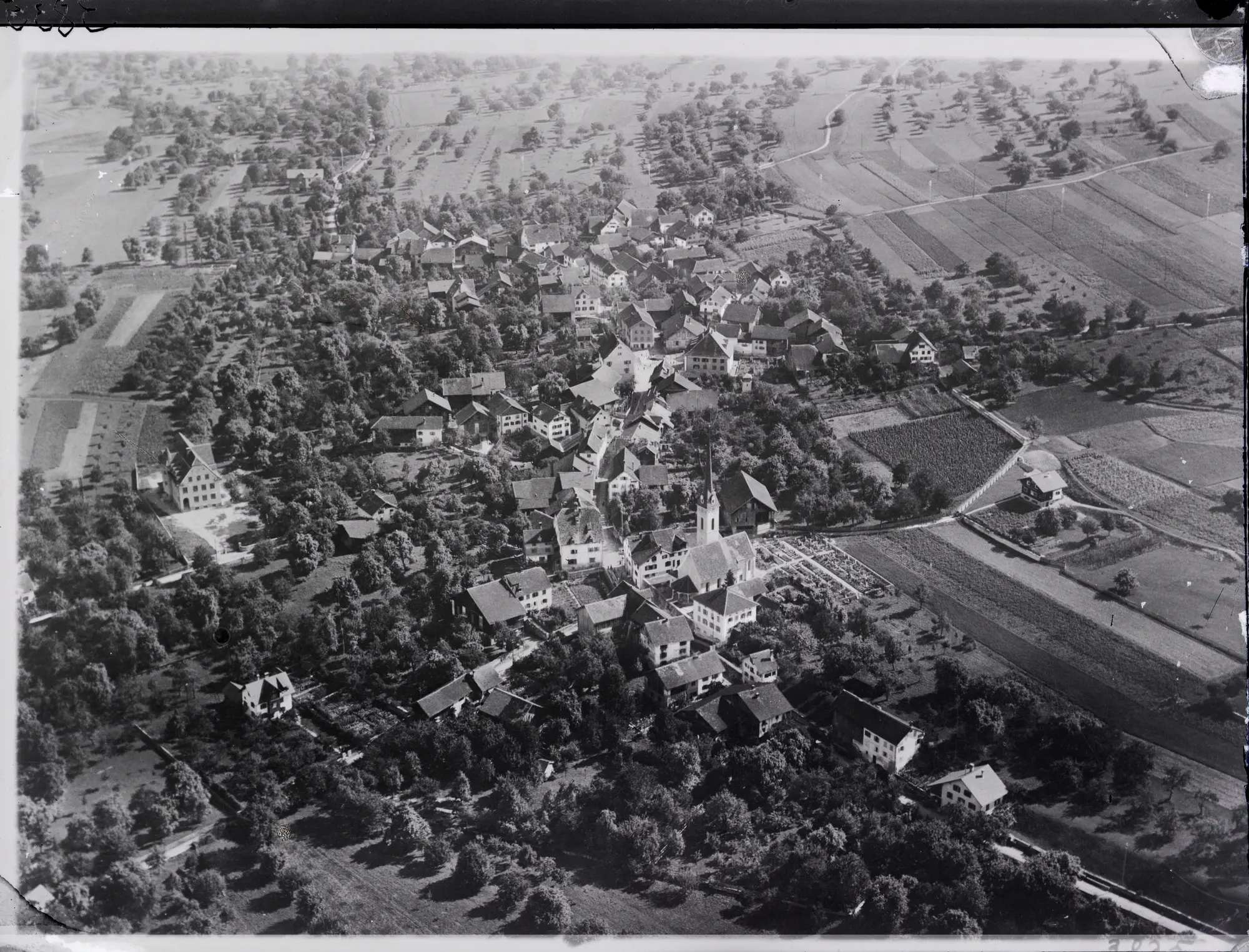
Igis lies on the Rhine near Landquart, and in 1850 it was a farming village of 637 people, with vineyards, orchards and livestock.7 Hegnauers had lived there since at least 1715, when a Jacob Hegnauer married in the village, the first of the name in its registers.6 Luzius was baptised at Igis on 8 December 1819, the son of Jakob Hegnauer and Christina Pleisch.9, 10 On 14 June 1840, at twenty, he married Anna Margreth Bernet in the Igis church, where she had been baptised in February 1819.11–15
Their five children were all baptised there: Johannes, later known as John, born 13 November 1840; Leonhard, born 25 April 1843; Christina, born 26 October 1845; Martin, born 20 February 1848; and Christian, born 18 February 1851.16–20 In December 1844 a Luzius Hegnauer, probably he, mortgaged a house in the Oberdorf at Igis for 300 gulden, and the mortgage register later names Jakob Hegnauer, probably his younger brother, as the debtor.21, 22
After the food shortages of 1848–50 many people in Graubünden decided to emigrate for good, and from the 1850s the United States was the country they chose most often.23 Igis had emigrants of its own: in 1845 the commune paid half the 1,232 francs it cost to send the Pfeifer family to New Orleans, Joseph Barfuss left in 1854, and the whole Florin-Disch family went in 1857.7 The notes on the old Igis families that record these departures say nothing of Luzius’s family, and nothing the study has found says why they went, or whether Igis helped to pay their passage.7 Nor was it a busy year to go: the United States recorded 7,953 Swiss arrivals in 1854 but only 1,780 in 1856.7
Leave to go
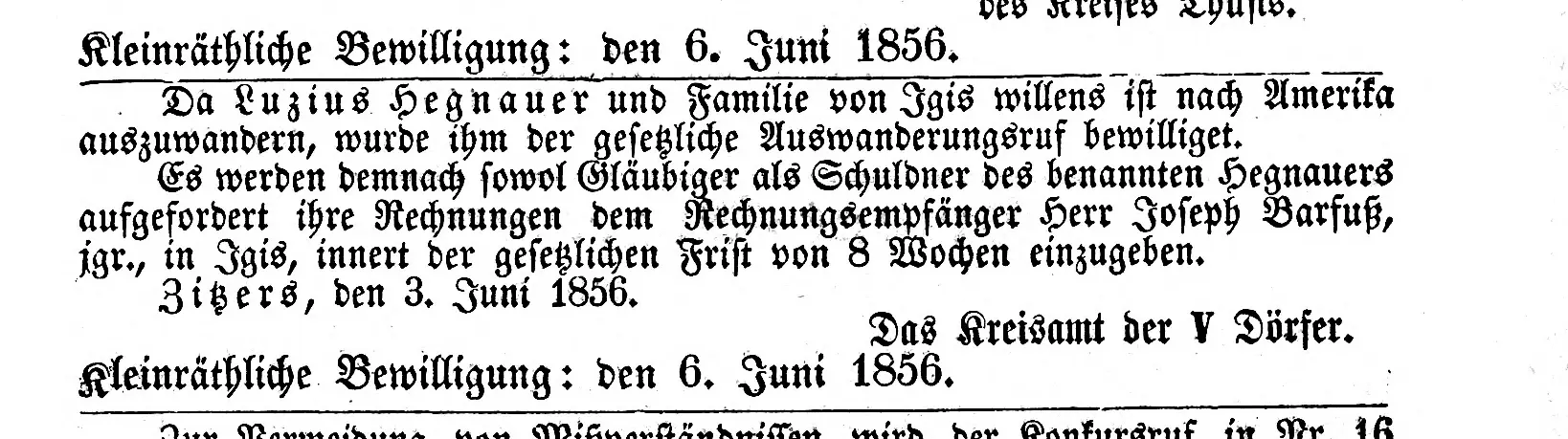
The earliest record of the family’s going is a notice in the cantonal gazette, the Amtsblatt des Kantons Graubünden, of 6 June 1856.24 Dated at Zizers on 3 June by the district office of the Five Villages, and approved by the Small Council on 6 June, it announced that Luzius Hegnauer “und Familie von Igis” intended to emigrate to America and had been granted the statutory emigration call.22, 24 Anyone who owed him money, or to whom he owed it, had eight weeks to send in the account to a receiver at Igis.22
How the family travelled from Igis to the sea is not recorded.25 There was no railway into Graubünden until 1 July 1858, when the line to Chur opened.25 Their neighbours show one way out: in April 1855 a party from Untervaz and other villages nearby, bound for Brazil, boarded omnibuses at the Tardis bridge at Landquart and went by Walenstadt, Weesen, Rapperswil, Zürich, Baden and Brugg, and over the Bözberg to Basel.25 The Hegnauers probably took much the same road.25 From Basel the railway carried emigrants across France to Le Havre.26 A French decree of 15 January 1855 required each emigrant to show 200 francs or hold a through contract, and let emigrants board the day before their ship sailed.26 The family must therefore have been at Le Havre by about 21 August, and had probably left Igis in the first half of the month.27
Thirty-six days, or thirty-eight
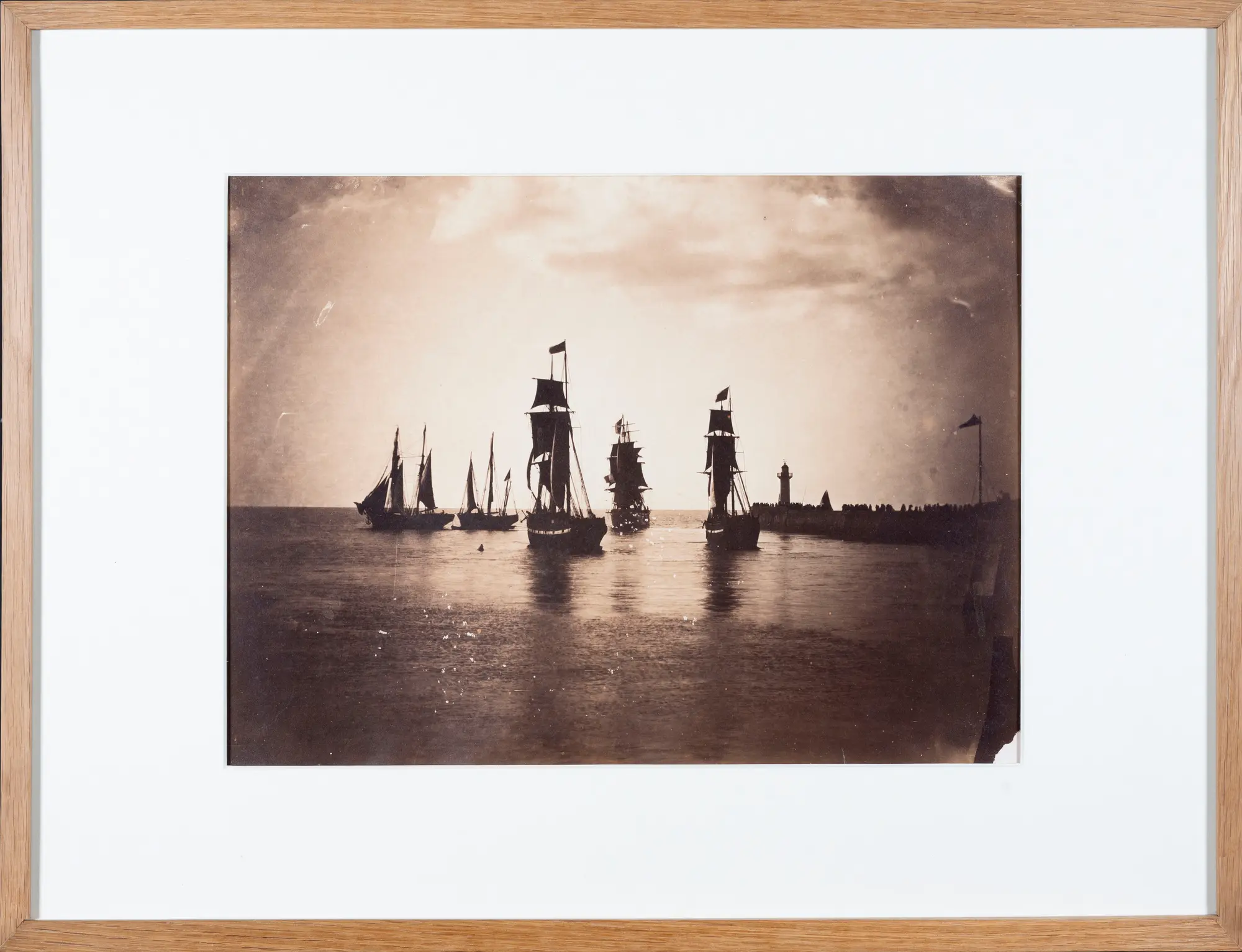
The Chace was an American full-rigged ship of 625 tons, about 133 feet long, built of oak and chestnut at Warren, Rhode Island, in 1850.28 She sailed out of New York for G. Bulkley & Son under Captain W. White, and in 1856 she was probably working the cotton trade, from Charleston to Havre with cotton and back to New York with emigrants and goods.28, 29 No picture of her has been found.30 On 21 August she lay at Havre, loading for New York, and she sailed the next day.1, 31
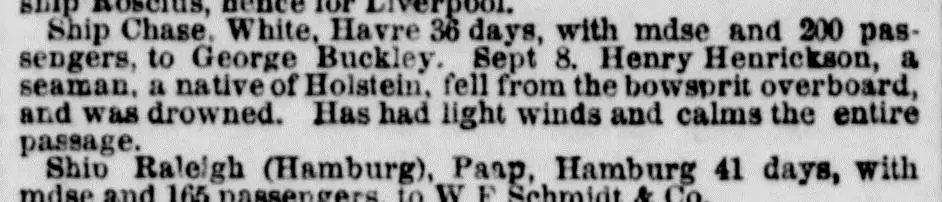
The New York Herald later reported that she “has had light winds and calms the entire passage”.3, 32 On 8 September a seaman, Henry Henrickson of Holstein, fell from the bowsprit and was drowned.32, 33 Six days later the brig Clinton, out of Nantes, met the Chace in mid-Atlantic and “spoke” her.33 Both ships reached New York on the same day, and the Clinton’s report went into the New-York Daily Tribune:34
Sept. 14 … spoke ship Chace, from Havre for New-York—23 days out—reported having lost a boy overboard, named Harry, on the 8th.35
The study takes Harry to be Henry Henrickson, and reckons from the Clinton’s position that after twenty-three days the Chace was only about a third of the way across.33 Neither paper reports a death, a birth or sickness among the passengers, though the same Herald column records deaths on other ships.33
The Chace reached New York on Monday 29 September 1856, “with mdse [merchandise] and 200 passengers” in the Herald’s words, and both papers gave her passage as 36 days from Havre.3 By the calendar it was 38, an ordinary length for a sailing ship of the time.33, 36 The Tribune’s list of cabin passengers that day names none for the Chace, so the Hegnauers, like almost all her passengers, probably travelled in steerage, between decks.34 The Herald page that reported her arrival also had news of “Trouble in Switzerland”, a royalist rising at Neuchâtel that had broken out after she sailed.34
They landed at Castle Garden, the state’s emigrant depot at the tip of Manhattan, which had opened in August 1855.37 Of the 141,625 people landed there in 1856, only 1,064 gave Missouri as their destination.37 Whether the Hegnauers were among them is not known, because the study has not yet recorded the destination column of their passenger list.38 The list, dated 30 September, calls them the Hegemann family: Lucie, 36, Marguerite, 37, Johann, 15, Leonhard, 13, Christian[e], 10, Martin, eight, and Christian, five.4 Their ages agree with their baptisms at Igis.39 The list also marks Lucie as female.4, 40
Illinois, briefly
How the family travelled west from New York is not recorded either.8 Where they went first is a little clearer. A county history of 1883, another of 1918 and Martin’s obituary of 1927 all put the family first in Madison County, Illinois, Martin’s “in Highland, Ill., later moving to Gasconade County Mo.”41–43 Margreth’s elder sister Barbara, who had married Christian Dönz at Igis in 1833, was living in the Highland area with her family by 1860, which may explain the choice.44, 45 The history of 1918 calls it a “permanent settlement”.40, 42 The study counts the stop as probable, and it can only have been short.40 Leonhard’s obituary, in 1916, says simply that he first settled in Gasconade County.46
In August 1857 a “Hegenaner Luzi” appears in a mortgage in the deed index of Gasconade County, Missouri, probably Luzius dealing in land within a year of landing.47 In October 1858 a “Luzius Hegnaner”, very probably he, witnessed a wedding in Boeuf Township.48 On 1 June 1859 Margreth gave birth to their last child, Barbara, in Gasconade County, the only one of the six born in America.49–51
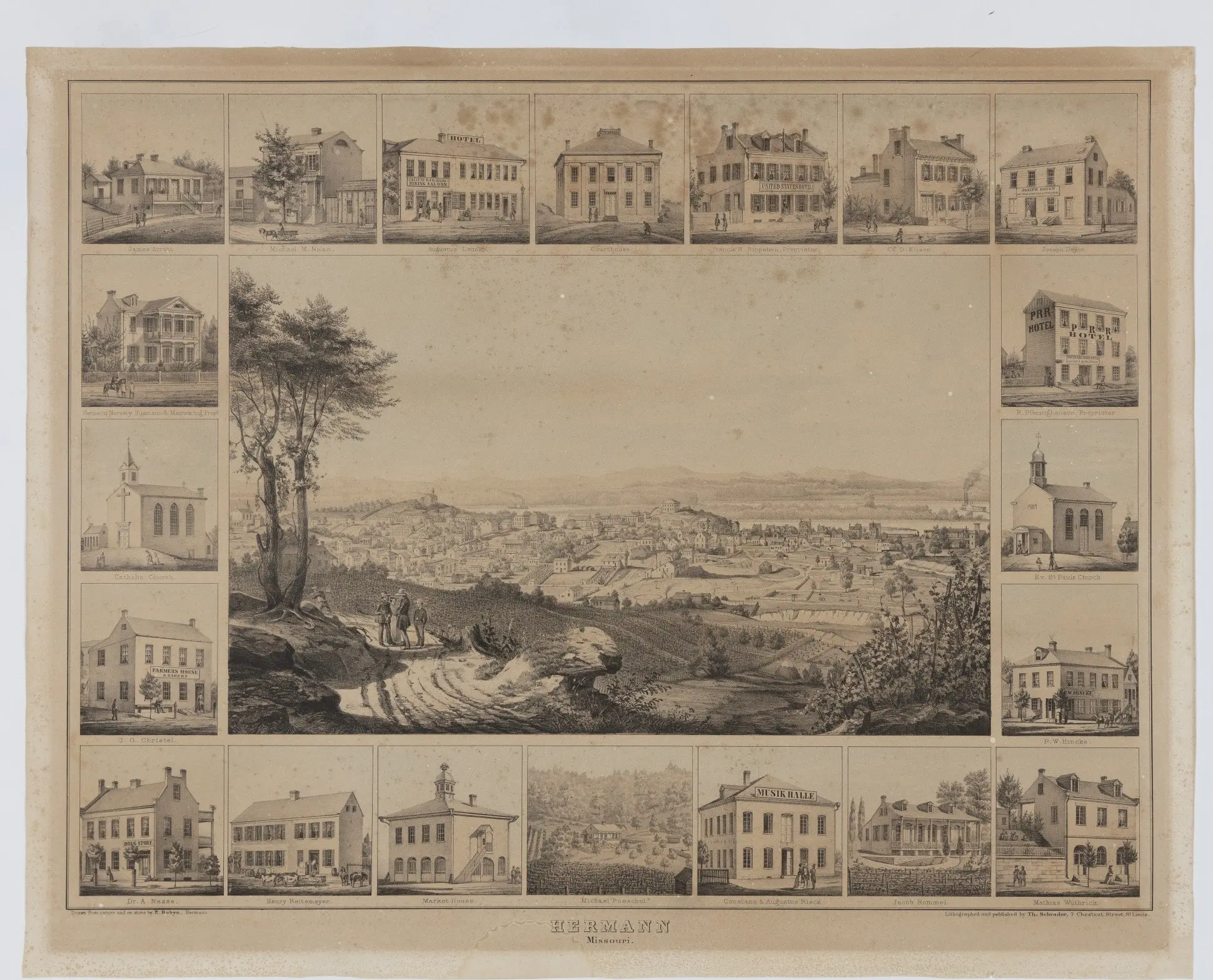
When the census taker came in 1860 he found them in Boeuf Township, with their post office at Hermann: “Luzi” Hegnauer, 41, farming, his wife, the older sons John and Leonhard working as farmhands, and the younger children at home.5, 52, 53 The next farms were Swiss too.52, 53 Germans had settled in large numbers in the Missouri River valley in the 1830s and 1840s, and Hermann itself had been laid out in 1837 by the German Settlement Association of Philadelphia.54, 55 A post office in the north-west of Boeuf Township was later named Swiss, because most of the people there came from Switzerland.55 In May 1860 Luzius and Margreth mortgaged their farm of 80 acres to secure notes of $200 and $250.56
What came after
Five years after the crossing, the Civil War took Luzius and his sons John and Leonhard into the Union army.57 Luzius enlisted at Hermann on 18 November 1861, nearly forty-two, and his company’s descriptive book gives his birthplace as “Igis Switzerland”.58, 59 In December 1868 he and Margreth sold the farm, by then 120 acres, for $1,200.60 By 1880 they were in Bates County, on the Kansas border, living with their unmarried son Christian and their daughter Barbara, and a county directory of 1884 lists them next to Leonhard, who had settled in the county in 1869.61–64 Margreth was apparently still living in 1884, and Luzius is last known to have been alive in July 1890, when at seventy he applied for an invalid pension.65–67 When and where either of them died is not known.68
The children who crossed on the Chace all lived into the twentieth century: Leonhard died in 1916, John in 1917, Martin in 1927, Christina in 1934 and Christian in 1935.69–73 Their father’s name never quite settled. He was baptised Luzius; the passenger list made him Lucie, the 1860 census Luzi and the army Lucius, and on the death certificate of his youngest son, Christian, in Oregon in 1935, he is “Luciero”.4, 5, 9, 58, 74 It is the same man every time.