The place behind the name
Hegnau
A village in the commune of Volketswil, canton Zürich. Every Hegnauer carries its name.
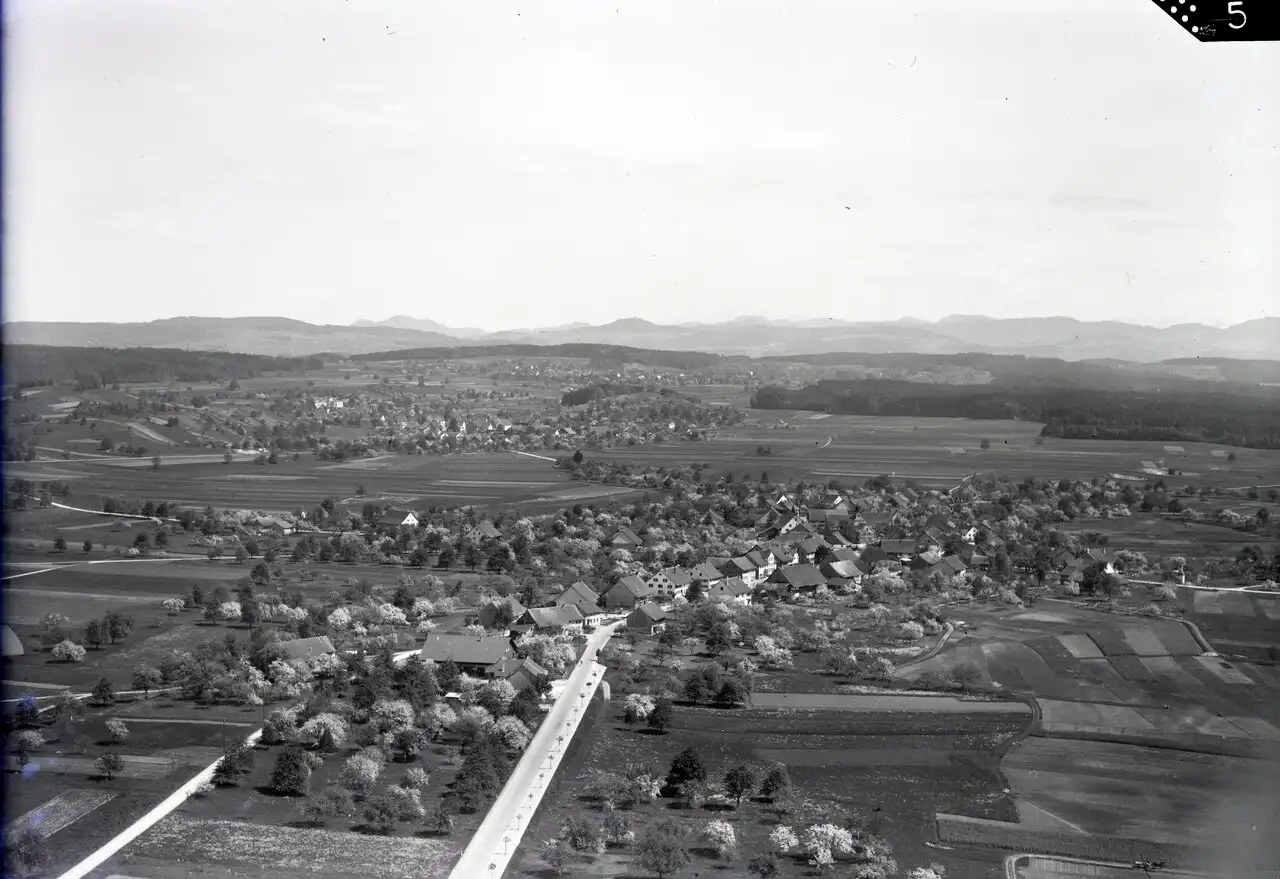
Hegnau from the air, 26 April 1946. Werner Friedli, ETH-Bibliothek Zürich, Bildarchiv / Stiftung Luftbild Schweiz, LBS_H1-008904, CC BY-SA 4.0
Every Hegnauer carries the name of a village. Hegnauer means "the person from Hegnau". Hegnau lies near Uster, in the canton of Zürich, and is today one of the five villages of the municipality of Volketswil (INDEX; Gemeinde Volketswil). For centuries the neighbouring villages laughed at the people of Hegnau, and the villagers passed the stories on themselves (pp. 3, 6–7). In 2010 the local history society, the Verein Ortsgeschichte Volketswil (VOV), gathered thirteen of the stories into a booklet. It was published for the two-hundredth anniversary of the school in the village chapel, the Chappeli (p. 4). This chapter covers four things: the village and its name, the Chappeli and its onion-domed tower, the stories, and what the records do and do not show about the place and the Hegnauer families.
01 · The village
The village and its name
Hegnau is an old place. Remains of Neolithic and late Bronze Age settlement have been found at Volketswil and Hegnau. An early medieval cemetery at Hegnau points to Alemannic settlers in the 6th or 7th century (HLS Volketswil). The Zürich place-name book, the Zürcher Siedlungsnamenbuch, gives the oldest record of the name as Hegenowa, about 1150 (ortsnamen.ch). It explains the second part of the name as the Old High German ouwa, "land beside water". The first part is most likely a man's name, Hagino or Hego, so Hegnau was "Hagino's land by the water" (Switzerland: where the Hegnauers lived, from the Zürcher Siedlungsnamenbuch).
The sources disagree about the first mention. The local history society's timeline says that a document first names Hegenowa in 1267, but it does not say which document (VOV timeline). The HLS gives no date: no HLS article on Hegnau itself was found, and the article on Volketswil says only that the lords of Hegnau are recorded in the 13th century (HLS Volketswil). The printed records settle part of the question:
- About 1150, Hegenowa. This is the place-name book's date (ortsnamen.ch). The study has the form and the date, but not yet the document behind them: the online record could not be opened again on 27 September 2026 to check which document it cites.
- 1244, villa Hegenowe. Antonius, a burgher of Rapperswil, gave his land in the "villa Hegenowe" to the abbey of Einsiedeln and received it back from the abbot as a fief. The abbey's historian took the place to be "probably" Hegnau (Ringholz 1904).
- 10 March 1267, Heginou. At Zürich, Walter von Vaz, guardian of the posthumous son of the late Count Rudolf of Rapperswil, confirmed a sale. The knight Rudolf "de Turri", a ministerial of Count Rudolf of Habsburg and of the late count of Rapperswil, had sold his land (predium) at Heginou to the Lazarite brothers of Gfenn for 14 marks of silver. The parchment original is in the Staatsarchiv Zürich (UBZH IV, no. 1343, pp. 53–54).
The Gfenn charter matches the VOV's year, but it spells the name Heginou, not Hegenowa. A record of 1267, apparently the same charter, was also the only dated one for Hegnau in Heinrich Meyer's collection of Zürich place names of 1849 ("in Hegino a. 1267"), and the Geographisches Lexikon der Schweiz repeated the year in 1904 ("1267 Hegenowe") (Meyer 1849, no. 607; GLS). The VOV's date probably comes from this older literature, though that is an inference: the VOV cites no source. The record of 1244 shows that 1267 is not the first mention. The study therefore keeps the place-name book's date, about 1150, and its document is still to be identified. The earliest record the study has read in print is the Gfenn charter of 1267.
In the 13th century a family of lords took its name from the village. "Those of Hegnau" were probably ministeriales of the Counts of Rapperswil, knights and officials in a lord's service (HLS Volketswil). Hegnau belonged to the lordship of Greifensee. The Counts of Toggenburg bought that lordship in 1369, and in 1402 Count Friedrich VII of Toggenburg pledged it to the city of Zürich (VOV timeline). From then until 1798 Hegnau was part of Zürich's bailiwick of Greifensee (HLS Volketswil). In church matters it belonged to the parish of Uster (HLS Volketswil). From 1519 Hegnau and Volketswil, with Zimikon and Kindhausen, separated from Uster step by step (VOV timeline). In 1589 the village received its first Einzugsbrief, the charter that set the terms on which newcomers could settle there, and from 1667 it had a school of its own (VOV timeline; HLS Volketswil).
The surname, with the -er ending that means "a person from", is found in the city of Zürich before it is found in the village.
- In the city's tax book for 1366 a "Johans Hegenower" is listed in the Neumarkt quarter, in the household of Irmense. The clerk first wrote "his cook", struck it out and wrote the name above.
- The same year a "Hegnöwer" was taxed in the Rennweg quarter.
- From 1372 to 1375 a woman called "the Hegnöwerin", the sister of Cuni Schönöwert, lived in the Linden quarter.
- In 1437 the tax registers name "Hans Hegnoͧwer von Hegnoͧw", Hans Hegnauer of Hegnau.
- In 1467–70 Herman Hegnauer was taxed at Hegnau itself, with his wife and their son Wilhelm.
- In the same years other Hegnauer households lived at Wangen (the next village), at Hirslanden, at Oberhusen and in the city. All of them were within about 10 km of Hegnau.
(Sources for this list: the tax books and Switzerland: where the Hegnauers lived.) The same registers use von Hegnau ("of Hegnau") for villagers with other surnames, such as Bela von Hegnöw in 1366 and Fren Schultheissin von Hegnöw in 1375. "Of Hegnau" alone therefore does not make someone a Hegnauer (tax books).
Roads have shaped the village. In 1830 a new state road from Schwamendingen by Uster to Hinwil was planned straight through Hegnau, cutting it in two (VOV timeline). Around 1840 the road from Zürich to Uster was improved and a new one was built from Hegnau to Fehraltorf. After that, Hegnau grew along the street (HLS Volketswil). Running water reached the houses of the Hinterdorf in 1889, the first part of the village to have it. Electricity and the first street lamps came in 1911. Hegnau's own civil commune was dissolved in 1932 (VOV timeline). Hegnau was once a village of farmers (pp. 6, 20). By 2021 it had close to 10,000 people and was the largest of Volketswil's villages (VOV timeline).
02 · The chapel
The Chappeli and its onion-domed tower
In the old heart of the village, at Alte Gasse 5, stands the Chappeli, Zürich German for "little chapel" (Gemeinde Volketswil, room booking). It began as a chapel of Our Lady. The sources disagree slightly about its age:
- The HLS dates it to the 13th century and records its first mention in 1503/04 (HLS Volketswil).
- The civil registry office calls it a building of the early 13th century (Zivilstandsamt), and so does the VOV's booklet for the school's jubilee (Schule Chappeli, p. 4).
- The local history society's timeline has it built about 1300 (VOV timeline).
According to the VOV, the oldest foundations show a Romanesque chapel with a rectangular nave, a narrower choir slightly wider than it was deep, and small round-arched windows. In 1503/04 it was enlarged into a Gothic chapel, and the Zürich authorities gave "those of Hegnau" eight pounds towards the work (VOV timeline; Schule Chappeli, pp. 4–5). None of the sources read for this chapter says who built the first chapel.
The tower carries an onion-shaped helm. The civil registry office names this Zwiebelhelm-Turm as the building's characteristic feature (Zivilstandsamt). The VOV's booklet for the school's two-hundredth anniversary, 200 Jahre Schule Chappeli (2010), dates the tower, its bell and its clock:
- 1503. Hans Füssli, a young bell-founder in Zürich, supplied a small bell of 147 pounds with a bright tone, inscribed AVE MARIA GRAC ("Hail Mary, full of grace"). Tradition says it was cast from a silver alloy and was painted black in wartime, so that foreign armies would not carry it off and melt it down (Schule Chappeli, p. 10). In the story of the donkey's egg, too, the council goes to Zürich to order the bell (p. 10).
- Before 1700. Hegnau fixed a tower clock to the tower's low, blunt top (Schule Chappeli, p. 6). The commune's accounts for 1696 pay Jacob Grossmann, the Zytenrichter or clock-keeper, his agreed fee of 4 pounds 6 shillings, and 1 pound 2 shillings more for cleaning and mending the clock (p. 9).
- 1755. The commune raised the polygonal choir to its present height and set on it a square storey for the bell and the clock, topped by a slightly narrower onion cupola. This is the onion helm the tower still carries. A clock with two dials, one facing up the village street and one facing down it, showed the time to people who lived further off (pp. 6, 9).
- November 1926. The civil commune of Hegnau bought a new tower clock with four dials from the Mäder firm of Andelfingen. A photograph of about 1915 still shows no dials on the north and south sides (p. 9).
- 1937–1938. The old bell cracked in 1937 and fell silent. In the winter of 1938 the Rüetschi foundry of Aarau supplied a new bell, inscribed Mein Klang ruft von und zu – zur Arbeit und zur Ruh. Hegnau 1938 ("My sound calls to and fro, to work and to rest"). Two men carried it up the tower (p. 10).
So the onion helm dates from 1755, and the tower has had a clock since the 17th century: one is recorded in 1696, the clock of 1755 had two dials, and the one bought in 1926 had four. The booklet names its sources only as a group: the Volketswil Neujahrsblätter, Beat Frei's histories of Volketswil, the archives of the VOV and of the school community, the schools' local-studies binder, and long-established Hegnau residents (Schule Chappeli, p. 1). It does not give a source for each date.
In 1810 the commune had the carpenter Jakob Thalmann of Zimikon take down part of the nave, raise the side walls and turn the chapel into a schoolhouse, with the schoolroom upstairs. The government gave 100 gulden. A 12-metre inscription on a roof beam on the Usterstrasse side records that the frame was raised on 28 August 1810 (Schule Chappeli, pp. 14–15). The VOV timeline gives 1811 for the conversion and 1819 for the schoolroom (VOV timeline). The school's two hundred years were celebrated on 22 and 23 October 2010, and the booklet of stories was published for that festival (p. 4). The young Traugott Vogel (1894–1975), later a writer for young people, taught the Hegnau children in the Chappeli schoolroom (p. 24). He taught at Hegnau and Dietikon before moving to Zürich in 1929, where he stayed until he retired in 1956 (HLS Vogel). The village councillors also met in the building (Zivilstandsamt).
The building served the village in other ways too. From 1810 the fire brigade kept its engine and gear on the ground floor. In 1844 a teacher's flat was built in, and the fire engine moved to the porch in the tower. In 1908 a new fire station was built against the south wall of the tower (Schule Chappeli, pp. 16, 30). In 1967 the school president called the Chappeli school "a victim of today's road traffic". The last school examination was held there in the spring of 1969, and the school closed. In 1979 the school community gave the building to the municipality free of charge. In 1982 the municipal assembly voted CHF 1,700,000 to restore it and build an annex, and the new rooms opened in 1985 (Schule Chappeli, p. 35). Today, carefully restored, it is used by the municipality:
- the Freiherren-Stube, "the barons' room", on the ground floor, in the historic core, is the civil wedding room;
- the old schoolroom upstairs is used for courses and meetings and can be hired;
- the Guggunäscht, "the cuckoo's nest", in the annex, is hired for club and family events and is the rehearsal room of the Hegnau mixed choir. The annex also holds the first-aid society's store.
(Sources for this list: Schule Chappeli, p. 35; Zivilstandsamt; Gemeinde Volketswil, room booking.)
The stories remember the building differently. In the tale of the grass on the church roof, the tower is a pointed spire, a Spitzhelmturm. The spire and the roof are covered with old, half-rotten wooden shingles, and grass grows thick on the damp north side (p. 20). The booklet of stories does not say whether the teller remembered an older roof or imagined one. The jubilee booklet describes the tower as low and blunt-topped before 1755 and onion-domed after it, so neither shape is a spire (Schule Chappeli, p. 6). Six of the thirteen stories are about the Chappeli:
- its building (p. 19);
- its place beside the road (pp. 8–9);
- its bell (pp. 10, 12);
- its roof and tower (pp. 20–21);
- its schoolroom (p. 24).
The teller of the grass tale also puts the former manor house of the Freiherr, the Baron, of Hegnau in front of the chapel (p. 20). The HLS describes the medieval lords of Hegnau more modestly, as probably ministeriales of the Counts of Rapperswil (HLS Volketswil). The chapel's wedding room is called the Freiherren-Stube (Zivilstandsamt).
03 · The stories
The stories of Hegnau
The foreword says that these stories have passed by word of mouth for centuries (p. 3). Most come from the local-studies binder of the Volketswil schools. Others were told by:
- the village chronicler Jörg Elmer;
- Jacques Frei of Hofstetten near Elgg;
- Alfred Temperli of Gutenswil.
One story comes from the Volketswiler Neujahrsblatt of 1974, and the longest from the Zürcher Kalender of 1920 (pp. 6–33). Nearly all are told at the villagers' expense. The Hegnauers in them are willing, hard-working and very literal-minded, and they know what their neighbours say of them. Before the well is measured, the Untervogt promises that this time Hegnau will prove the mockers wrong (p. 13). In these stories a "Hegnauer" is simply a person from Hegnau.
Vom Guggu (The cuckoo), pp. 6–7. This is the story that gave the booklet its name. In spring, the old belief goes, you should have money in your pocket when the cuckoo calls, and then you will not run short all year. A mischievous travelling journeyman encouraged the villagers to believe that the best thing of all would be to own the bird. They collected timber in secret, so that the people of Volketswil, or even of Zürich, would not get wind of the plan and snatch the bird first. When the cuckoo called at last, they built a high fence round its tree under the Untervogt's orders, to keep it on common land. The bird had long since flown. The booklet adds that the neighbouring villages supplied the mockery for centuries.
Vom grünen Sonntagsrock (The green Sunday coat), pp. 8–9. The villagers had long felt that their little church stood too close to the road. At a village meeting the Untervogt demanded that something be done, and the parson took him at his word. The schoolmaster proposed that the village's nearly two hundred strong men simply push the Chappeli further back. They pushed, but when the Untervogt went round to look, nothing had moved. On the schoolmaster's advice he laid down his green Sunday coat to mark the spot. While the men heaved again, a passing journeyman made off with the coat. When the Untervogt came back, he announced that the church had moved and was now sitting on his coat. Rather than push it back, the village paid for a new one, and he wore it to church the next Sunday.
Das Eselei (The donkey's egg), p. 10. The council went to Zürich to order a bell for the Chappeli and dined in a guild house at the ratepayers' expense. None of them could make sense of the menu. The Gemeindeammann saw a gentleman at the next table spread a little mustard very thinly, decided it must be costly, and ordered a bowl of it. He opened the meal with a whole spoonful, and tears came to his eyes. The schoolmaster comforted him: the commune was paying. At the market a trader sold them a pumpkin at a high price as a donkey's egg, due to hatch in six weeks. On a nearby hill every voter took a turn of three hours sitting on it. On the forty-second day, at a change of turns, the teacher tripped over the pumpkin. It rolled down the slope and burst against a tree, and a hare that had been hiding behind the tree ran off in fright. The whole village chased it, calling on the little donkey to run home to Hegnau. Jacques Frei of Hofstetten near Elgg told this story.
Die Glocke (The bell), p. 12. War came close to Zürich, and the Hegnauers feared for their greatest treasure, the Chappeli's bell. With great effort they took it out on a lake boat and sank it in the Greifensee. One clever villager marked the place where it lay by putting a sign on the boat's bow. After the war there were Hegnauers left alive, the boat was still afloat and the mark was still plain to see, yet the bell lies at the bottom of the lake to this day. Jacques Frei heard the story from his father, who had almost fallen in love with a woman from Hegnau. Anyone who doubts the story, he adds, is welcome to go and look.
Die Hegnauer messen die Tiefe ihres Brunnens (The Hegnauers measure their well), pp. 13–15. In a dry season the village's eight draw-wells ran low. The cattle and goats were driven to the pond on the south side of the Alte Gasse, between the Chappeli and the Gupfen. The women and older girls fetched water there too, carrying the pails on their heads on a ring of straw.
The Untervogt and spokesman, Andreas Gull, had spent some summers in foreign service in Holland, and the others envied his tales of distant lands. He proposed that they first find out how deep the well was. No measuring rod was long enough. So he would hang from a beam laid across the well, the next man would hang from his feet, and so on down, until the lowest touched the water. Afterwards the tailor and the Ehgaumer Bickel would measure each man with the ell, and the schoolmaster would add up the lengths. They fetched a beam from Schaggi. Gull went down first, then Ueli Reutlinger, then Jakob Fischer. As the fourth man let himself down, Gull called out that he must just get a better grip, let go and spat on his hands. Everyone fell in, and there, the story ends, they lie still.
Eine Volkszählung in Hegnau (A census), p. 16. The Untervogt wanted to know how many people lived in Hegnau. He called everyone to the village square to count together, but every count came out different. Then a clever villager pointed to a large, half-dried cowpat near the village fountain. If everyone pressed his nose into it, he explained, they could count the prints. A brown-green nose showed who had already had a turn, and when every nose was coloured the prints were counted, and Hegnau at last knew how many people it had.
Wie man in Hegnau Nägel machte (Nails), p. 18. The village ran out of nails and had no money to buy more. One sharp villager reasoned that nature makes large things from small ones, since small pieces of potato planted in spring give a crop of large potatoes in autumn. The next spring the whole village went out and planted pins in neat rows, expecting nails by harvest.
Aushub beim Bau des Chappeli (The spoil), p. 19. When the Chappeli was built by the Uster road, what to do with all the excavated earth stirred up the village. A village meeting settled it: they would dig a new hole and bury the spoil in it. This story is taken from the Volketswiler Neujahrsblatt of 1974.
Das Gras auf dem Kirchdach (The grass on the church roof), pp. 20–21. A cheerful young day-labourer came along the road from Schwerzenbach, past the marshes, expecting harvest work. He had heard that everyone laughed at the Hegnauers and wanted to test them for himself. A young maid, Babettli, was drawing water at the well in front of the inn, the Stammbaum ("family tree"). There he pointed out the grass on the church roof next door to a little crowd: the older Heich, Jokeb, Heusli and others. It was almost a sin, he said, to leave such grass unmown, so they should put a goat up there to graze. Heich knew how: a rope round the goat's neck, and a pulley fixed on the tower. As the goat rose, its tongue hung out, and the villagers took this for hunger for the rich grass. At the top it was dead. When they realised, they turned on the stranger, but he had already gone.
Wie die Hegnauer ihre Häuser heizten (Heating the houses), p. 22. In a bitter winter the firewood ran low and no one could get their parlour warm. s'Hannisse Heiri proposed that everyone bring a few logs to the square, so that the whole village could share one great fire. The moment it blazed, everyone hurried home and threw open their doors and windows to let the village heat in.
Heuwätter flüg uf Hegnau zue! (Hay weather, fly to Hegnau), p. 23. After a whole summer of rain the villagers longed for dry weather, at least for the second hay crop. A wanderer told them that an apothecary in Zürich sold hay weather, so they sent one of their men to buy some. The apothecary thought it over and handed him a box that he must on no account open. Near Schwerzenbach the man's curiosity won. A hornet flew out, and he ran after it, calling on the hay weather to fly to Hegnau. Alfred Temperli of Gutenswil told this story.
Ein ungewöhnlicher Schulbesuch (An unusual school inspection), p. 24. A farmer from Zimikon sat on the school board, and it was his duty to inspect the Chappeli school, where Traugott Vogel was then teaching. On a grey, wet day, just right for spreading liquid manure, he decided to do both at once. He drove up on his manure cart behind his horse, Fritz, and cracked his whip in the road outside. When the teacher angrily threw open the window, the farmer told him to bring out the visitation book. From his seat on the barrel he wrote up the visit he had planned in advance, full of praise for teacher and pupils, and drove on to his fields. Jörg Elmer told this story.
Warum die Hegnauer wasserscheu wurden (Why the Hegnauers became afraid of water), pp. 26–33. This is the longest tale. A rich man and a poor man lived outside the village. The rich man wanted the poor man's one fine cow. When the poor man would not sell it, the rich man and his farmhand killed it in the night. The Vogt was the rich man's cousin, so a complaint would be useless, and the poor man set off to Zürich to sell the hide.
In the great forest on the way he climbed a fir tree to hide from a band of robbers. They sat down beneath it to share out sacks of gold. Wrapped in the cowhide, he dropped among them, crying that he was the devil. The robbers fled, and he rode home on their gold-laden horse.
He had his wife borrow a bushel measure from the neighbour to measure the gold. The neighbour had smeared its bottom with bird-lime and found a Bernese doubloon stuck to it. The poor man explained that he had sold the hide to a dwarf in the Fällander Holz for a Rappen a hair, and forty million hairs at that. He said he still had to return the dwarf's horse. The neighbour offered to take it back for him, and killed all his own cattle that night. When he reached the forest with the hides, the robbers recognised their horse and hanged him from the same fir.
The poor man moved to the Greifensee, bought a farm and a fine herd, and stopped at the Vogt's inn in Hegnau on his way through. The envious villagers accused him of robbery. He told them that he had brought the herd up by magic from the bottom of the Greifensee, which was really an enchanted common pasture, and offered to show them. By full moon he led them to the shore and showed them his herd reflected in the water. The Vogt sent his farmhand in first. The splash sounded like chumm ("come on"), so the Vogt jumped after him, and the whole village followed.
They crawled out dripping and went home to bed with elderflower tea. For more than a hundred years, the tale ends, no Hegnauer would go near a lake. They drank only wine and schnapps, and the Vogt was the one innkeeper in the Zürich countryside who never watered his wine.
The booklet took this story from the Zürcher Kalender of 1920, where it appeared under the name of J. J. Reithard (p. 33). He was very probably the Zürich writer Johann Jakob Reithard (1805–1857), whose collection of Swiss tales and legends appeared in 1853 (HLS Reithard). If so, the story was already old when the calendar printed it.
04 · The families
Hegnau and the Hegnauer families
The name is what joins the place to the families. In the booklet every villager is a Hegnauer and every village woman a Hegnauerin (pp. 6–33). That is the everyday word for someone from Hegnau, and it is the surname: Hegnauer means "the person from Hegnau" (INDEX). The first bearers of the name appear in the city of Zürich, in the tax books of 1366, and not in the village itself (tax books).
A few medieval Hegnauers can be placed at Hegnau or beside it:
- Hans Hegnoͧwer "von Hegnoͧw" in 1437;
- Herman Hegnauer, taxed at Hegnau itself in 1467–70, with his wife and his son Wilhelm;
- Hanns Hegnauer at Wangen, the next village, in the same years.
The tax books name no relationships beyond the household. None of these men can yet be joined on paper to a later family, because the church books begin only in the mid-1500s (INDEX; tax books).
The families the study has mapped begin later and further away (INDEX):
- Elgg. Hegnauer baptisms are indexed at Elgg from 1553, and the Elgg family held one of the two old Hegnauer citizenships. Elgg is about 20 km from Hegnau (Elgg, canton Zürich: the Hegnauer families, 1553–1875).
- Uster. Uster was Hegnau's old parish. Hegnauers are found there from 1647, and the family there from 1730 was probably a branch of the Elgg line.
- Igis. The Igis line, the owner's own, begins with Jacob "Hagenauwer", who married at Igis in 1715. Where he came from is not recorded. His -auwer spelling is the form used around Zürich and Elgg, which points towards the Zürich area but proves nothing. The Igis citizens' notes derive the family name from Hegnau, and that is a statement about the name, not about Jacob's ancestry (study page draft, quoting the Bürgergemeinde Landquart).
- Seengen. Seengen in Aargau held the other old citizenship, and no record links it to Elgg or Igis.
None of these lines is documented as descending from people who lived at Hegnau. The name records where some ancestor once came from. It does not show who he was, when he left, or whether all Hegnauers share him. The name may also have been formed more than once, by different people who came from Hegnau. A Y-DNA test of a direct male-line Hegnauer from each line is the test that could tell (INDEX).
The nearest candidates are still unproved. FamilySearch's index has baptisms of 1548 and 1550 at Fehraltorf for children of a Jacob "Hegnoren" or "Hegnorer". At Illnau-Effretikon it has "Hegnaucker" and "Hegnacker" entries from 1559 to 1624. Both are neighbouring parishes. If the register images confirm the name, the Fehraltorf entries are the oldest of the name in any church book, older than Elgg's of 1553. Of all the church-book families found so far, this one lived closest to Hegnau (INDEX; the list of variants; variant harvest).
The booklet adds no genealogical evidence: no one named in it bears the surname (source note). It has only two small echoes, and neither is evidence of a family link:
- The Untervogt of the well story is called Andreas Gull, and a real Hans Gul "von Hegnau" is recorded in 1483 (Switzerland: where the Hegnauers lived).
- Two of the stories were handed down by Jacques Frei of Hofstetten, a village near Elgg, whose father had almost fallen in love with a woman from Hegnau (pp. 10, 12). Elgg is one of the two places where Hegnauers held an old citizenship.
05 · Open questions
Still to find
- The document of about 1150. Find the record behind the place-name book's Hegenowa of about 1150, and check that it means this Hegnau: Hegenowa is also a medieval Latin form of Hagenau in Alsace. Find the Einsiedeln record of 1244 in print too; the Zürcher Urkundenbuch's volume for 1235–1254 could not be searched online.
- The tower's dates at first hand. The jubilee booklet gives the dates of 1696, 1755 and 1926 without a source for each. Check them in Beat Frei's histories of Volketswil and in the Kunstdenkmäler volume for the districts of Pfäffikon and Uster (Hans Martin Gubler, 1978, pp. 522–542, cited by the HLS), which was not available online. The cantonal Denkmalpflege's reports that should cover the restoration of 1982–85 (the 10th and 11th, for 1979–1986) are not online either. The report for 1964–65 was read: its Volketswil entries are archaeological and do not mention the chapel.
- The first printings of the stories. Look in the Volketswiler Neujahrsblatt of 1974 and the Zürcher Kalender of 1920, and check whether the water-shy tale is in Reithard's collection of 1853.
06 · Sources
Sources
- Booklet (cited by page): Madeleine Jordi and Mayken Strub (collectors), Vom Guggu und andere wahre Hegnauer Geschichten, illustrated by Beni Merk (Volketswil: VOV Verein Ortsgeschichte Volketswil, 2010), 36 pp., vov-volketswil.ch/fileadmin/tb_theme/1_medien/dokumente/gedenkschriften/vom_guggu_und_andere_wahre_hegnauer_geschichten.pdf (accessed 27 September 2026). See the source note.
- Schule Chappeli (cited by PDF page): VOV Verein für Ortsgeschichte Volketswil, 200 Jahre Schule Chappeli (booklet of the jubilee exhibition, Volketswil, 2010), 37 pp., vov-volketswil.ch/fileadmin/tb_theme/1_medien/dokumente/gedenkschriften/200_jahre_schule_chappeli.pdf (accessed 27 September 2026). The pages are those of the PDF, whose pp. 1 and 2 are both title pages; the booklet has no printed page numbers. The year is that of the jubilee, which matches the PDF's creation date of 19 October 2010. Its companion, Schulgeschichten im Hegnauer Chappeli (19 pp., in the same folder of the VOV site), was also read; it is about the teachers and the school and says nothing about the tower.
- ortsnamen.ch: "Hegnau", Volketswil, record 7059591 (data of the Zürcher Siedlungsnamenbuch), ortsnamen.ch/de/record/7059591. The study read it on 26 September 2026; on 27 September 2026 the page could not be displayed without a browser.
- UBZH IV: Urkundenbuch der Stadt und Landschaft Zürich, vol. IV, 1265–1276 (Zürich, 1898), no. 1343, pp. 53–54 (10 March 1267; original: Staatsarchiv Zürich, "Spanweid nr. 2"), and the index, "Heginou". Read in the Bavarian State Library's digital copy, digitale-sammlungen.de/de/view/bsb00073416 (accessed 27 September 2026).
- Ringholz 1904: Odilo Ringholz, Geschichte des fürstlichen Benediktinerstiftes U. L. F. von Einsiedeln, vol. 1 (Einsiedeln: Benziger, 1904), under the year 1244. Read in the Internet Archive's copy, archive.org/details/MN5062ucmf_1, image 188 (accessed 27 September 2026).
- Meyer 1849: Heinrich Meyer, "Die Ortsnamen des Kantons Zürich aus den Urkunden gesammelt und erläutert", Mitteilungen der Antiquarischen Gesellschaft in Zürich 6 (1849), no. 607, "Hegnau". Internet Archive, archive.org/details/mitteilungendera61849zric (accessed 27 September 2026).
- GLS: Geographisches Lexikon der Schweiz, vol. 2 (Neuenburg: Attinger, 1904), "Hegnau". Internet Archive, archive.org/details/bub_gb_o5lDAAAAYAAJ (accessed 27 September 2026).
- HLS Volketswil: Ueli Müller, "Volketswil", Historisches Lexikon der Schweiz (HLS), version of 2012 (edited 19 September 2017), hls-dhs-dss.ch/de/articles/000136/2017-09-19 (accessed 27 September 2026).
- HLS Vogel: Ingrid Bigler-Marschall, "Vogel, Traugott", HLS, version of 2011 (edited 12 August 2013), hls-dhs-dss.ch/de/articles/012369/2013-08-12 (accessed 27 September 2026).
- HLS Reithard: Rosmarie Zeller, "Reithard, Johann Jakob", HLS, version of 2009 (edited 18 August 2010), hls-dhs-dss.ch/de/articles/012212/2010-08-18 (accessed 27 September 2026).
- VOV timeline: Verein Ortsgeschichte Volketswil, "Hegnau", vov-volketswil.ch/ortsgeschichte/doerfer/hegnau (accessed 27 September 2026).
- Gemeinde Volketswil: "Willkommen", volketswil.ch/portraet/willkommen.html/14; and, for the room booking, "Chappeli – Schulstube", Volketswil Online: Raumreservation, rbs-volketswil.ch/cmsapp/de/raumreservation/?show=details&action=none&raum_id%5B0%5D=5678 (both accessed 27 September 2026).
- Zivilstandsamt: Zivilstandsamt Volketswil, wedding-venue listing "Chappeli Volketswil", hochzeit.ch, hochzeit.ch/de/benutzerprofile/dienstleister/100374/w/1637307490.php (accessed 27 September 2026).
- Study files:
- Map of the Hegnauers: every line at a glance (the name; the lines; Fehraltorf);
- Hegnauers in the Zürich tax books, 1366–1470 (the tax books, 1366–1470);
- Switzerland: where the Hegnauers lived (the Zürcher Siedlungsnamenbuch's derivation of the name, and "von Hegnau");
- Elgg, canton Zürich: the Hegnauer families, 1553–1875;
- the list of variants;
- Variant-spelling harvest, FamilySearch historical records;
- sync/wikitree/Hegnauer_Name_Study.proposed.wiki (the study's WikiTree page draft, for the Bürgergemeinde Landquart's notes on the Igis family).