The oldest line
Three centuries at Elgg
For more than three centuries the church books of Elgg, a small town in the north-east of canton Zürich, recorded the oldest and largest Hegnauer family the study has found. This is what their index can say about them, and what it cannot.
Elgg, a small town in the north-east of canton Zürich, has the oldest continuous Hegnauer family in the church books.1 Its first entry in the Elgg books is the baptism of Anna, daughter of Hans Hegnauer and Margreta Wister, on 3 September 1553, and the last the study has from them is the baptism of Otto Hegnauer on 26 September 1875.2, 3 In between, the study has charted more than four hundred Hegnauers there, with the men and women they married: the largest Hegnauer community in its records.4, 5 The Familiennamenbuch der Schweiz records only two Hegnauer citizenships older than 1800, Elgg and Seengen, in Aargau.6 The Hegnauers of Uster were probably a branch of the Elgg family.7 Nearly everything below comes from FamilySearch’s index of the Elgg registers. The images of the registers themselves have not been read, so a name, a date or a link may still change.8, 9
A small, square town
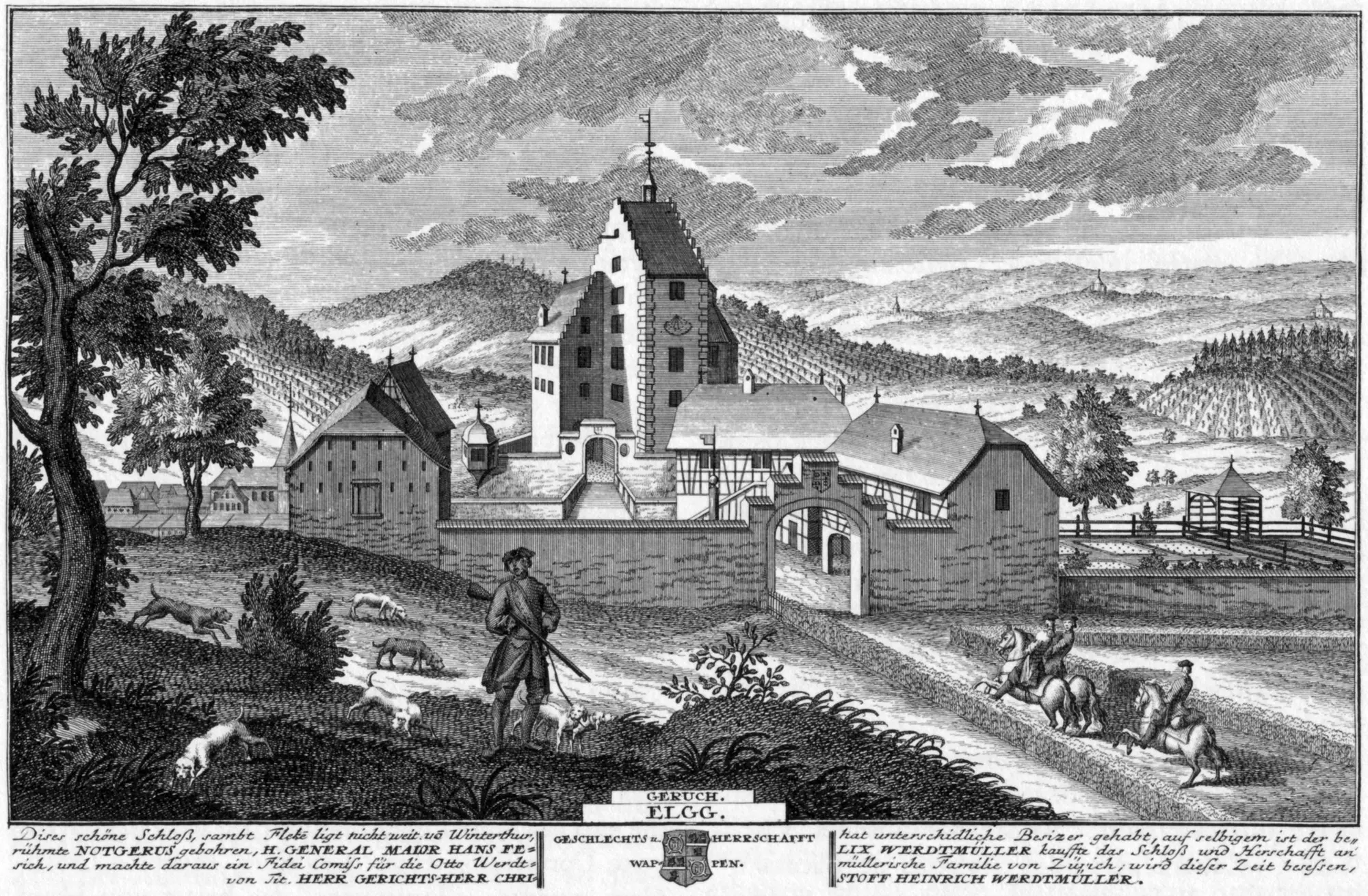
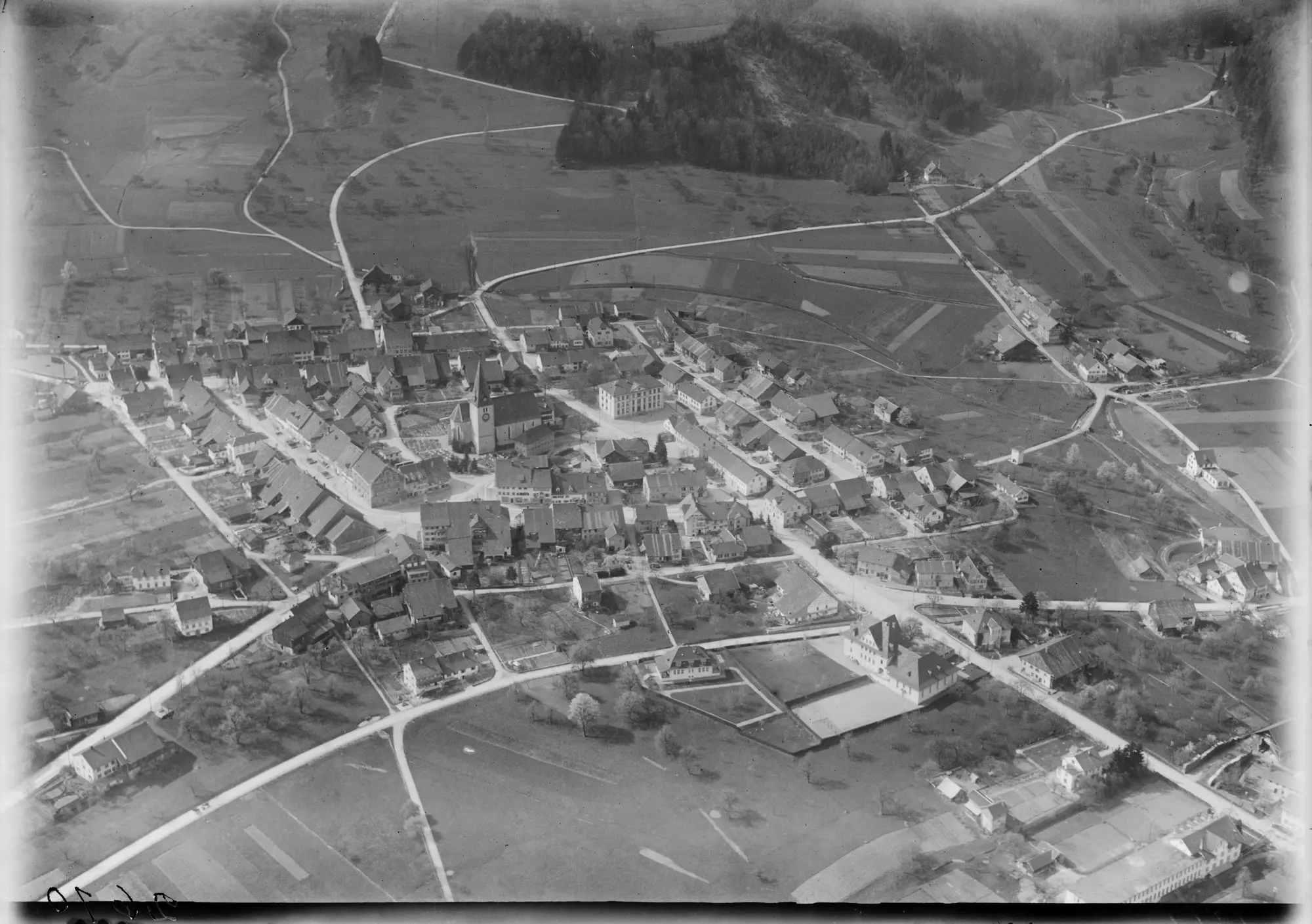
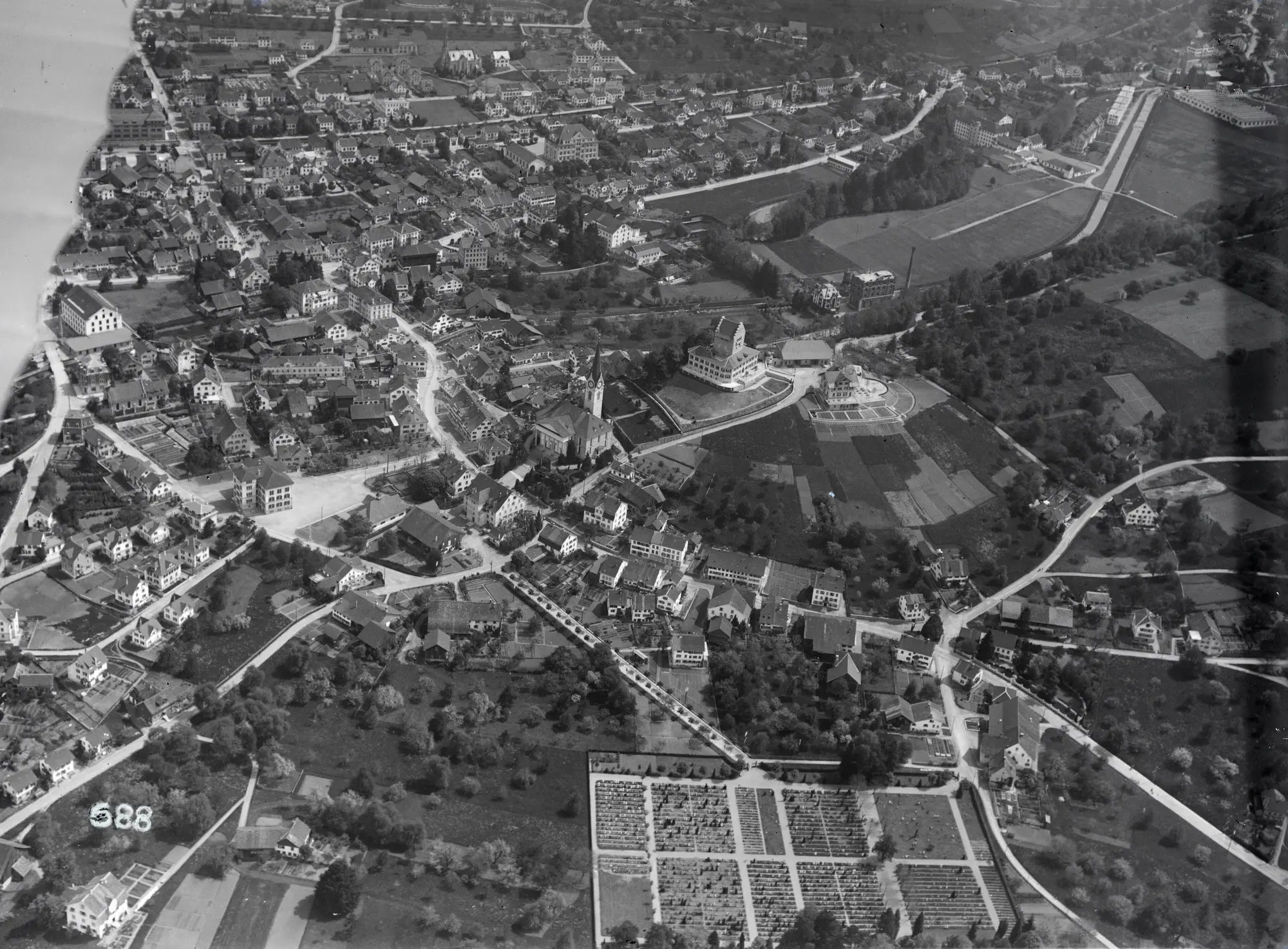
Elgg lies on the upper Eulach, about 20 km from Hegnau, the village that gave the Hegnauers their name.1, 10, 11 It had received town rights in 1371, and in 1553 it was a small, square town, protected by a ditch and palisades, with town gates.10 Zürich held the high court there through its bailiwick of Kyburg; the castle and the lower court belonged to the lords of Hinwil until 1576, when a Zürich man, Hans Heinrich Lochmann, bought them and had the castle rebuilt as a manor house.12 Johann Caspar Ulinger’s engraving of 1741 shows it above the little town, with a hunting party in the foreground.13
Zürich imposed the Reformation on Elgg in 1524, against considerable resistance, and in 1526 it ordered that church books be kept; Elgg’s survive from 1551.9, 10, 14 The parish was a large one. Besides the town it took in the villages of Hofstetten and Schottikon, parts of Bertschikon and Hagenbuch, and four villages across the border in the Thurgau, which returned to the Catholic faith and broke away from Elgg towards the end of the sixteenth century.15, 16
Hegnouwer, Hegner, Hegnauwer
In the index the spellings follow one another: Hegnoüwer or Hegnouwer from 1553 to 1615, Hegner from 1569 to 1636, Hegnauwer from the 1590s to 1692, and Hegenauer or Hegnauer from the 1670s.17 The Hegner years are the awkward ones, because Hegner is also the name of a family that became citizens of Winterthur in 1430.18 At Elgg, though, the Hegner are the Hegnauers: the same couples are indexed under both spellings.17 Brosshans Hegnauer and his wife Barbara Rugger are Hegnouwer in April 1570, when two of their children were baptised together, and in 1573 the parents of Ursula, probably theirs, are indexed as “Grashans Hegner” and “Barbel Kügger”.19–22 At two baptisms, in 1700 and 1703, the family of Hans Jacob Hegnauer and Margretha Stadelmann is entered as “Hegnauerschmid”, Hegnauer the smith.17, 23, 24
The variety once cost the study a century. Its first search of the index, under the spelling Hegnauer, found no Elgg baptisms before 1695, and its first map of the families began in 1659.4, 25 Searched again under the other spellings, the index gave up 464 more entries for the Elgg families, going back to Anna’s baptism in 1553.5, 26
The first families
No record says where the first Elgg Hegnauers came from.4 The Zürich tax books of 1468–70 list a Klaus, or Cly, “Hegner” at Elgg with his wife; their editors index him under Hegnauer, but whether he was one is uncertain.27 In the church books, the nearest earlier entries of the name are two baptisms of 1548 and 1550 at Fehraltorf, between Elgg and Hegnau, for children of a Jacob “Hegnoren” or “Hegnorer”, and nothing links him to Elgg.28–30
Within three years of Anna’s baptism, four Hegnauer couples had married at Elgg: Jacob and Anna Knobel on 15 July 1554, Blasius and Otylia Nussberger on 27 January 1555, Hans and Anna Petter on 15 June 1555, and another Hans and Elsa Furer on 9 February 1556.31–34 Yet another Hans, with his wife Salome Peter, had daughters baptised from 1558, and how many different men these four Hans Hegnauers were, the index cannot say.35, 36 Blasius and Otylia had two sons named after their father, in 1557 and 1566, and between them a daughter, Genovefa, whose story is told in Lives worth telling.37–39 Otylia was buried on 17 July 1602, forty-seven years after the wedding, entered as Blasius’s wife.40, 41
Between February and October 1629 the burial register recorded at least seven Hegnauers.36 Two were sons of Baschi, or Sebastian, probably the Hans and Rudolph baptised in 1603 and 1599, and in one fortnight of August the register has an Ulrich, then a burial whose name the index garbles as “Lienhart Hörer”, with Ulrich as the spouse, and then Anna, daughter of Ulrich.42–46 The index gives no cause of death for any of them; the study’s report lists the year among its open questions as “the plague of 1629”.36
The couples of the later seventeenth century include Hans Jacob Hegnauer and Elsbeth Stadelmann, married on 28 April 1656, Heinrich and Cathrina Schawöl in 1661, Andreas and Margreth Brännwald on 21 June 1669, Johannes and Anna Gassner in 1681, and Hans Heinrich and Margreth Schöchli on 26 June 1683.47–51 How they descend from the families of the 1550s, or from one another, cannot be shown, because no Elgg marriage entry before 1700 names the groom’s father.52 Where a name is unique at the right age the study makes a bridge, but none is better than probable.52, 53
Peter and Esther
The best-connected of the early couples is Peter Hegnauer and Esther Trachsler, who married at Elgg on 13 December 1698; the study’s chart gives them twenty-six descendants over four generations.54, 55 Peter was probably the Peter baptised on 14 January 1672, son of Andreas and Margreth Brännwald: the only Peter baptised at Elgg in the index before 1700, and twenty-six at the wedding.52, 56 Their children were baptised between 1700 and 1710: Peter, Hans Heinrich, Jacob, Madalena and Hans Rudolff.57–61
Hans Heinrich, baptised on 16 February 1701, probably went to Uster. On 26 September 1730 the Uster register records the marriage of Hans Heinrich Hegnauer, son of Peter, to Dorothea Meyer, and the Elgg register has the same wedding on the same day; no other Elgg Peter had a son of that name and age.58, 62–64 Uster was the old parish of Hegnau itself.65 Hans Heinrich’s children were buried there from 1736, and the Uster Hegnauers of the later 1700s are of the right age to descend from him, but no record names their parents, and after 1751 the chain breaks.7
Across the border
Heinrich Hegnauer married Anna Barbara Trachssler at Elgg on 29 June 1767, a wedding the Zürich register entered too, and they had at least thirteen children baptised at Elgg between 1768 and 1795.8, 66–69 When Heinrich died on 17 March 1829, his burial entry gave his birth year as 1737, but no baptism of his is indexed and his parents are unknown.55, 70 The study’s chart gives the couple thirty-four descendants in five generations, the main line of the nineteenth century.55
Their daughter Anna Barbara, baptised on 3 November 1782, married Hans Ulrich Huber at Sirnach, over the border in the Thurgau, on 15 April 1806, and the Sirnach entry names her parents.71–73 Her children were baptised at Sirnach, and the Elgg register entered the last of them, in 1826, as well; when she died on 8 March 1829, nine days before her father, both registers recorded her burial.74–77 Her brother Zacharias, baptised in 1795, was probably the Zacharias who married Elisabetha Liner at Elgg in 1829. They lived at Aadorf, and their children were entered both there and at Elgg, the family’s home parish, once with the father indexed as “Joachim”.78–83
Earlier daughters had married across the border too. Maria, probably the Maria baptised at Elgg on 6 January 1715, married Jung Hans Bollinger on 1 December 1735, a wedding indexed at both Dussnang and Bichelsee; their children were baptised at Bichelsee and at Elgg, where she was buried in 1786.64, 84–89 Sabina, baptised on 17 June 1714, married Caspar Engeler at Gerlikon, near Frauenfeld, on 19 October 1760, at forty-six, and the Thurgau entry gives her exact birth date and her father’s name; she was buried at Frauenfeld on 20 August 1763.90–93 Every Hegnauer entry the study has found at Aadorf, Aawangen, Ettenhausen, Sirnach, Bichelsee, Dussnang, Gerlikon, Felben and Wetzikon belongs to an Elgg family.7
Too many Heinrichs
Two boys named Hans Heinrich were baptised at Elgg in 1746, on 3 May and 19 June, the sons of Hans Ulrich Hegnauer and Magdalena Bulod and of Jacob Hegnauer and Elisabeth Grütert.94, 95 Two Heinrichs buried in 1817 and 1824 were both entered as born in 1746, the husbands of Anna Spiller and of Susanna Stadelmann.96, 97 The study’s report takes them to be the same two men, but which is which the index cannot tell, and both are left unlinked.55
The main line’s longest branch hangs on another Heinrich. Heinrich and Anna Barbara’s son Heinrich, baptised on 3 December 1780, is possibly the Heinrich who married Anna Margaretha Huggenberger in 1819, though other Heinrichs born in those years are candidates too.64, 98, 99 Their son Ferdinand, born on 10 September 1828, probably married Elisabetha Kohler at Wynau, in canton Bern, in February 1852, and their son Wilhelm Jacob was baptised at Elgg that May.100–102 A Wilhelm Jacob, possibly he, and Maria Stahl had a son, Otto, born on 15 August 1875: the last Hegnauer child in the study’s Elgg records.3, 55
Other traces lie further afield. About 1806 a Lausanne woman named Pachoud gave a sworn procurator of the canton of Zürich her power to recover what she was owed “pour l’apprentissage de Salomon Hegnauer”, for the apprenticeship of Salomon, son of one Jacob Hegnauer, whose surety was a “Hegnauer d’Elly”, which the study reads as Elgg.103 The act, known from a machine transcription, does not say what trade Salomon was learning or how the debt was settled, and the study places him, probably, in the Elgg family.103, 104 Maria Elisabeth, a daughter of Heinrich and Anna Barbara, died on 26 May 1867 at Königsfeld in Baden, the Moravian settlement in the Black Forest, and the burial entries there and at Elgg both record her.52, 105, 106 A Rudolf baptised at Wetzikon in 1858, son of Heinrich Hegnauer and Elisabetha Brändli, possibly married Emma Müller at Rorschach in 1883.107, 108
The Elgg baptism, marriage and burial books on FamilySearch end in 1875, and the study’s Elgg records end with them.109 The family did not: a Swiss historical dictionary of 1928 says that the Elgg Hegnauers became citizens of Zürich in 1877 and of Winterthur in 1900, and the Familiennamenbuch der Schweiz lists Elgg among the Hegnauer citizenships still held in 1962.110 Where the first of them came from, and how most of the families join up, is still open. The study’s report names what could settle it: the images of the registers, the Zürich population registers of 1634–1780, which list every Elgg household with ages, and an Elgg citizenship record.111 Until someone reads them, the Hegnauers of Elgg remain easier to count than to join up.