War
Hegnauers in the Civil War
A Swiss farmer from Gasconade County, Missouri, and two of his sons served the Union: the father, in his forties, and one son guarding the Pacific Railroad, the eldest son three years in the cavalry. Their own records say where each man was, and where they cannot.
In 1856 Luzius Hegnauer brought his wife and five children from Igis, in the Swiss canton of Graubünden, to America, and by 1860 the family was farming in Boeuf Township, Gasconade County, Missouri.1–3 By the end of 1861 Luzius and two of his sons were in the Union army.4–6 The father, in his forties, and his second son, Leonhard, spent their war guarding the Pacific Railroad; the eldest, John, baptised Johannes, served three years in the cavalry, from Missouri to Mississippi.7, 8 Their muster rolls and descriptive books survive, and with the pension indexes they follow the three men from enlistment into old age and, in John’s case, to a soldiers’ home in Kansas.9–13
The Home Guards
The war reached Gasconade County on 12 June 1861, when, on the orders of Governor Jackson and General Price, the Pacific Railroad’s bridge over the Gasconade River was set on fire and “the draw fell into the river”.14 The Hermann paper reported that General Lyon had ordered the town’s Home Guard to guard the county’s railroad bridges, and that on 14 June two more companies, raised “unter den Farmern”, among the farmers, were sworn in.14 Julius Hundhausen’s battalion of five companies, one of them Captain Stocklin’s Company D, guarded the bridges through the summer until it was disbanded on 1 October 1861.15
Service cards of these Home Guards, so far read only in machine transcription, name a “Lucius” (once as “Lazurus”) and a “Leonard Hegenauer” in Captain Stocklin’s company.16 A father and son of those names fit only Luzius and Leonhard, so both very probably served in it.14 Leonhard, who had turned 18 that April, later gave 16 June 1861 as the date of his first enlistment, and a county history says that he “enlisted in 1861 for three months”.17–19 At the start of 1862 Missouri’s adjutant general counted “Hundhausen’s Battalion 400” among the three-month Home Guards, men “more than decimated by diseases” and “yet unrecognized and unpaid”.14
Father and son at Hermann
When the Home Guards were disbanded, Hundhausen raised a three-year battalion of the U.S. Reserve Corps from their men at Hermann.14, 15 Leonhard enlisted in it on 14 October 1861, as a private in Company C.5 The company’s descriptive book gives him as 19, five feet five and a half inches tall, with a dark complexion, brown eyes and black hair, a farmer born in “Grisson”, that is, Grisons, the canton of Graubünden.20
Luzius followed on 18 November, as a private in Company D, although he was nearly 42.4, 21 His first muster roll calls him “Lucius Hegeman”, which is very nearly what the passenger list of 1856 had called the whole family.1, 14 The descriptive book shows a man of five feet six inches, with a dark complexion, grey eyes and brown hair, a farmer born at “Igis Switzerland”.22, 23 In the same company was George Krättli of Untervaz, the next village to Igis, who had been born the same year as Luzius and was also living in Boeuf Township in 1860.24, 25
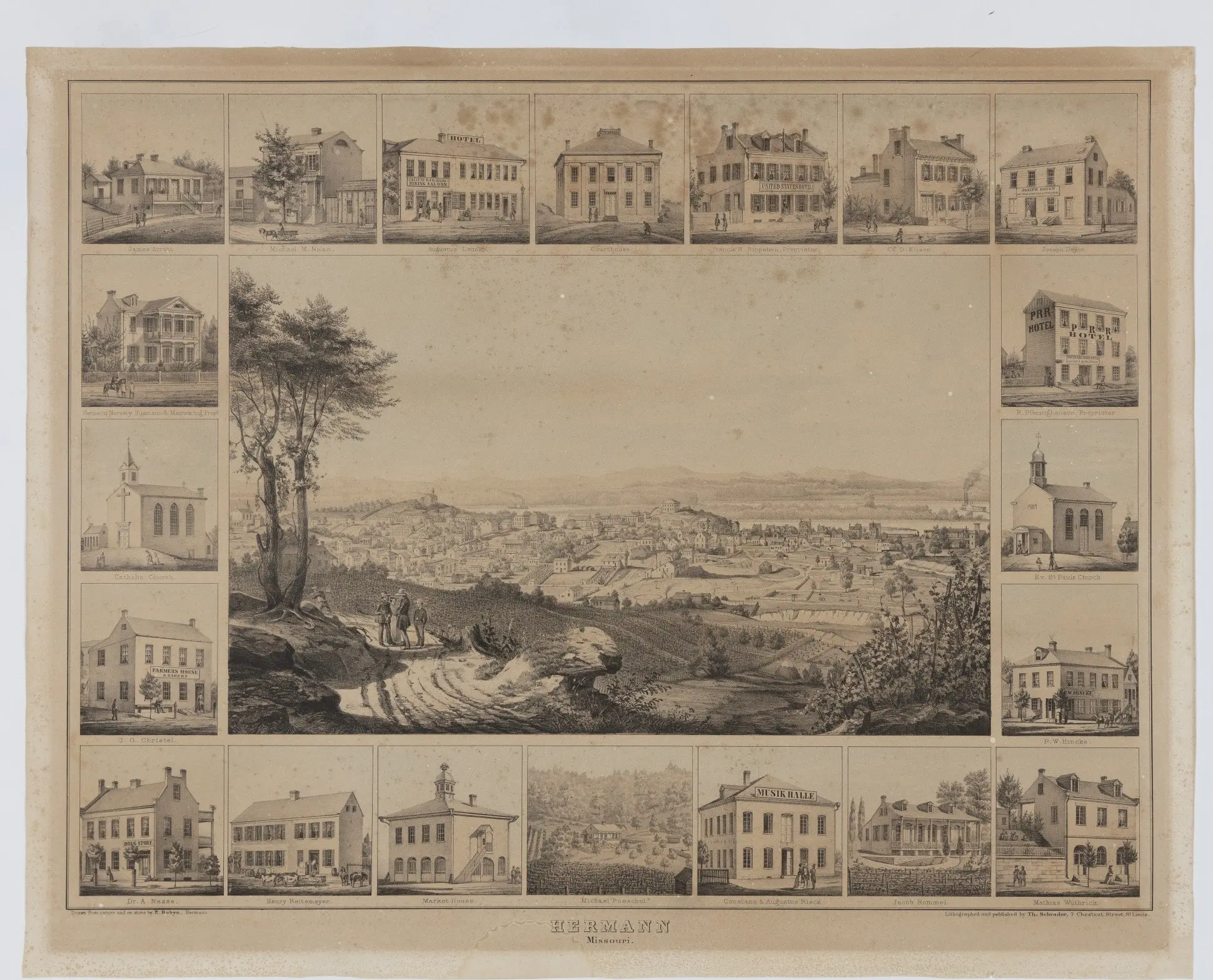
Both men were present on their companies’ rolls to the end of 1861, so they were very likely at Hermann that winter, and Luzius’s muster-in roll was made there on 9 January 1862.14 On 18 January the battalion was joined with the 3rd Regiment of the Reserve Corps to form the 4th Missouri Infantry, seven companies strong: Leonhard’s company became Company E, under Captain Balthasar Mundwiller, and his father’s became Company F.14
The third son, Martin, was 13 when the war began.26 His obituary of 1927 says that he was “not old enough to enlist” and stayed at home “to help provide for the mother and younger children while his father and two brothers served”.27
Five quarters of a year at the bridges
The regiment’s duty was to guard the Pacific Railroad, the line through Hermann and over the Gasconade bridge.28 Its headquarters were at Pacific City, and in June 1862 General John M. Schofield wrote that he was “relying on Hundhausen”, the regiment’s commander, “to guard the entire Pacific Railroad as far as the Osage”.14, 29 The National Park Service’s history of the regiment lists no battles, and neither man can be credited with one.14, 28
Luzius was present on every muster roll of 1862.4, 30 Leonhard was present until the autumn, when the October return marks him “absent sick at hosp[ital]”; at the end of December he was still “present, Sick”.20 In November, while he was ill, people escaping slavery on Loutre Island, across the Missouri, “placed themselves under the protection of Capt. Mundweller”, his captain, and when four of them were jailed at Hermann the acting provost marshal had them freed that night.14 Whether Leonhard had any part in it is not recorded.14
By the end of 1862 the regiment had been brought into St. Louis, and on 1 February 1863 both men were mustered out at Benton Barracks, Luzius aged 43 by his roll and Leonhard 20.14, 30, 31 That May a letter to the Hermann paper protested that the discharged Reserve Corps men were now to be enrolled in the militia: they had volunteered first, had still not been paid for their Home Guard service, and had fought sickness “an den Brücken”, at the bridges, for “Fünf Vierteljahre”, five quarters of a year.14 No militia record for any Hegnauer has been found.14
The cavalryman
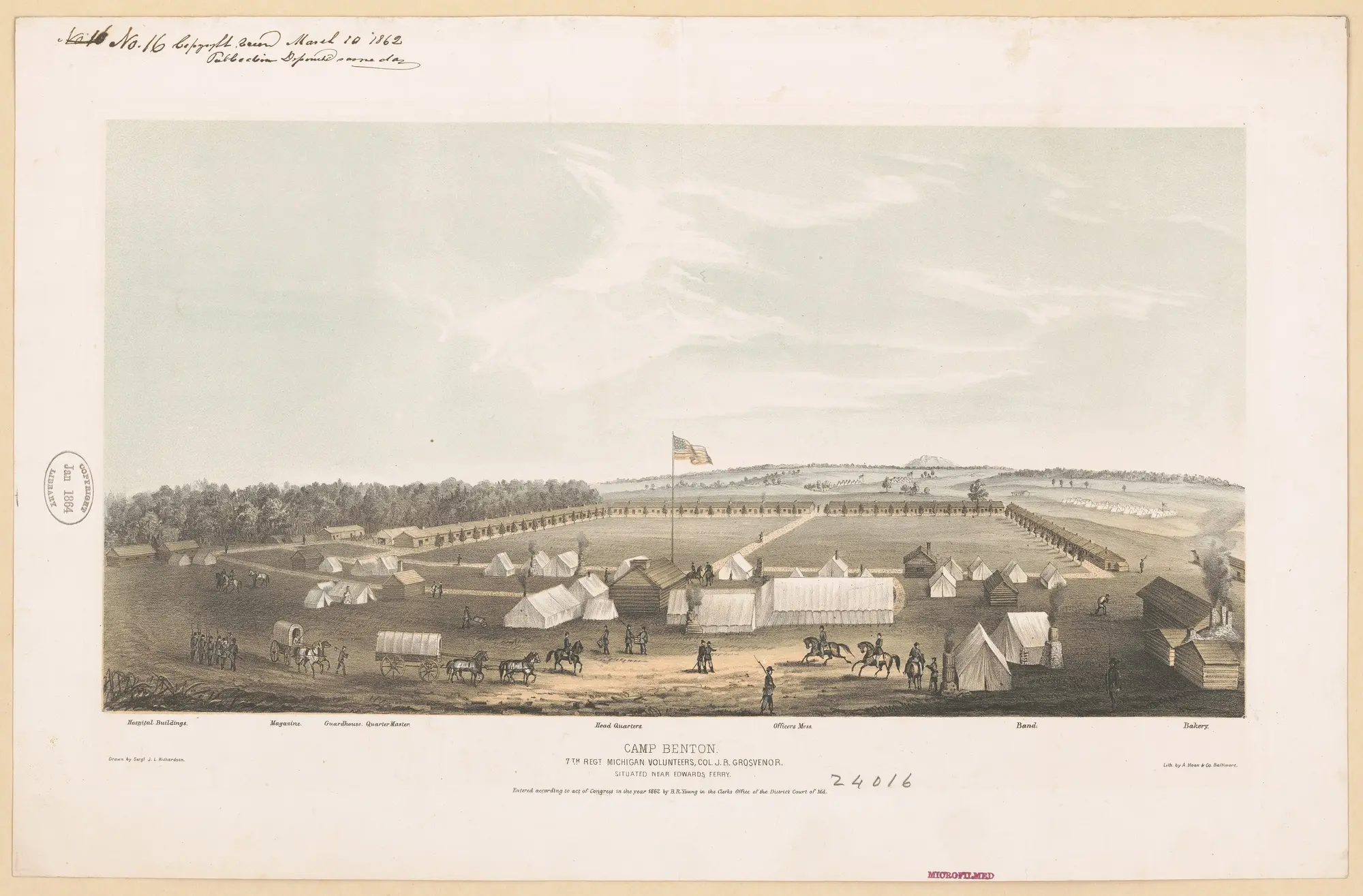
In August 1861, a few months before his twenty-first birthday, John enrolled at Camp Benton, St. Louis, in Captain Ernest Pfaff’s company of mounted volunteers, and on 18 September he was mustered in at Bird’s Point, across the Mississippi from Cairo, aged 20.6 The company became Company A of the Benton Hussars, then Company A of the 5th Missouri Cavalry, and in November 1862 Company B of the 4th Missouri Cavalry.6, 32 His muster rolls survive for all three years, and he was carried present on 17 of the 18 bi-monthly rolls.6 A private in February 1863, he was a corporal by 15 April and kept that rank to the end.6, 33 The cards record no sickness, wound, capture or furlough; the only losses charged to him are a water bridle, at 92 cents, in the summer of 1863, and some ordnance stores in 1864.34
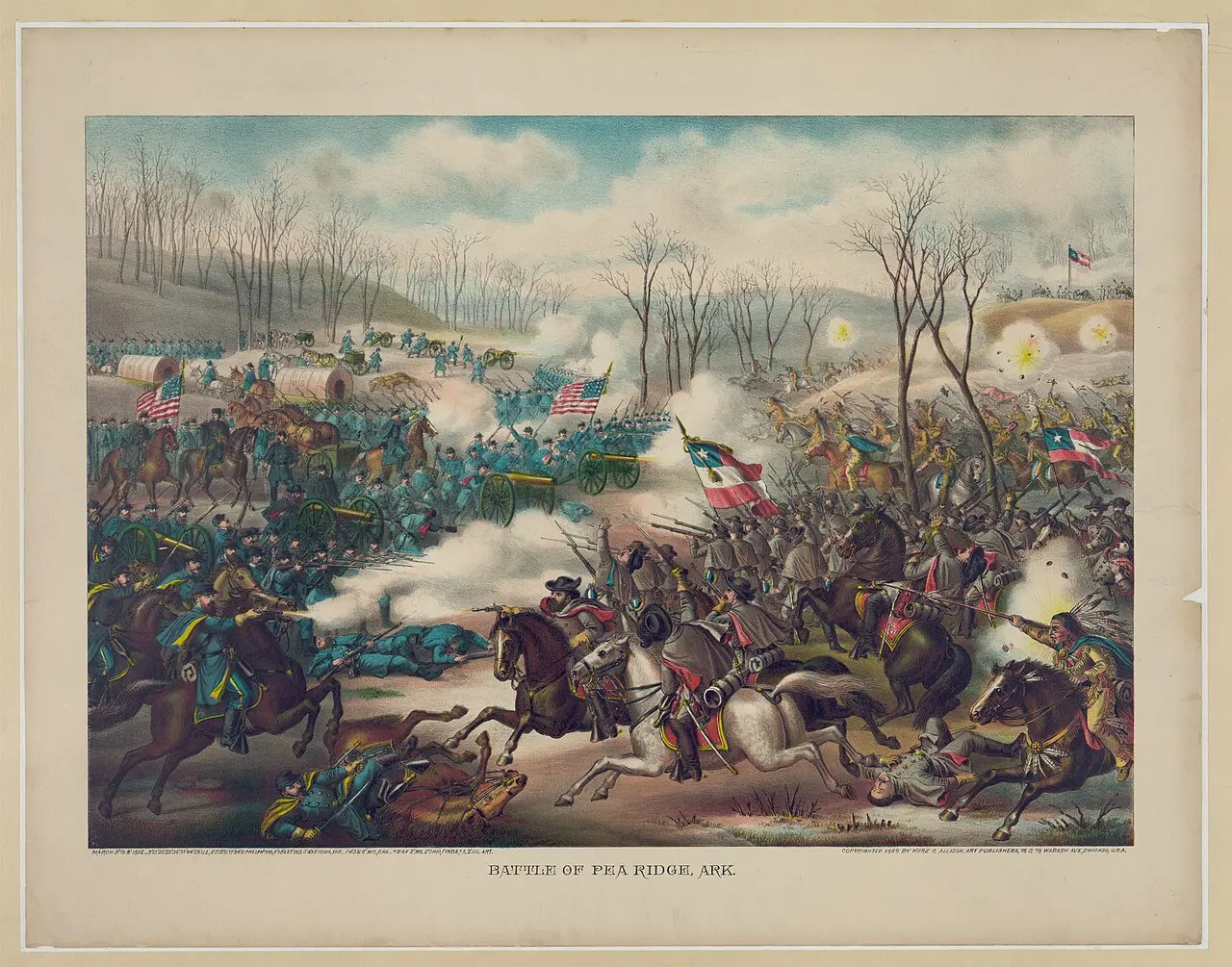
A “present” on a roll describes a man on the day it was taken, so the rolls cannot prove that John was in any particular fight.35 At Bentonville, Arkansas, on 6 March 1862, 28 men of Company A under Captain Pfaff were in the rear guard covering General Sigel’s withdrawal, and at Leetown the next day, in the Battle of Pea Ridge, Colonel Joseph Nemett took Company A back to recover an abandoned gun of Welfley’s battery.36 John was present on the rolls of 28 February and 30 April, so he was very likely there, though whether he rode with the party that saved the gun is not recorded.6, 37 By the same reckoning he was very likely at Ivey’s Hill, near Okolona, Mississippi, on 22 February 1864, where the 4th Missouri Cavalry made a sabre charge that a rail fence stopped.6, 36
At Brice’s Crossroads on 10 June 1864 his regiment cut its way out of the rout “with drawn sabers and revolvers”, and where John was that day cannot be said: present on 30 April, he was away on the roll of 30 June, “On expedition with Genl A. J. Smith”.6, 36 In September the company’s re-enlisted veterans and recruits went off with General Mower, while the men whose three years were running out stayed in camp near Memphis.32 John was one of those, and in October 1864 he was mustered out at St. Louis as a corporal “for expiration of term”, with a $100 bounty due to him.6, 38
Price comes to Hermann
Luzius still held his farm when the war came back to the county: in March 1864 he and his wife Margaretha had mortgaged its 80 acres to Hermann Kemper for $500.39 That autumn Sterling Price’s Confederate army invaded Missouri: the county militia was ordered into service on 28 September, and on the evening of 3 October Price’s troops took Hermann.40, 41 The Hermann paper told how the townsmen fired the town’s old cannon until “die Zündkapseln ausgingen”, the percussion caps ran out, and how “Hr. Nebel”, a Swiss gunner from Basel-Landschaft, then spiked it.40 The women and children took refuge in the caves nearby and on Graf’s Island, and the next day a Confederate detachment destroyed the Gasconade bridge, the one set on fire in 1861.40
Where Luzius and his family were during the raid is not documented, and nothing records what happened to them.42 One record brings it close. On 18 October 1864 a “Lucius Hegnaner”, very probably Luzius, swore an affidavit, now among the papers of the Union provost marshals, that on 4 October Henry Domeyer had “betrayed union men in his neighborhood to the rebels”.43 Six years earlier a “Luzius Hegnaner” had witnessed a wedding at Domeyer’s house in Boeuf Township.44 Only a machine transcription of the affidavit has been read, and what came of the charge is not known.40
Rosters and pensions
In June 1890 the census made a special count of surviving Union veterans.45 At Pleasant Gap, in Bates County, where father and son had settled after the war, it found “Lucius Hageneur”, private, 4th Missouri Infantry, and “Leonard Hageneur”, private, Company E, whose disability was deafness.18, 19, 45, 46 On 15 July 1890, evidently under the new pension act of that June, Luzius applied for an invalid pension, and in August 1891 two Kansas City papers listed “Luzius Hegnauer” among the Missouri pensions just granted.47–49 They are the last records of him: when and where he died is not known, and no widow ever applied for his pension.10
John applied for a pension on 19 August 1890, and the “John Hegenauer” in a Kansas City list of pensions granted in December 1891 is probably him.11, 50 In 1909, at 68, he entered the Western Branch of the National Home for Disabled Volunteer Soldiers at Leavenworth, Kansas.13 He died there on 31 December 1917 and was buried in the Leavenworth National Cemetery, whose register enters him under his old company, B of the 4th Missouri Cavalry.51, 52
In August 1897 two Springfield papers printed a roster of Union veterans, and it includes “L. Hegnauer, Co. E, 4th Mo.”: Leonhard’s company, not his father’s.53, 54 Leonhard applied for an invalid pension in 1903 and again in 1907, and was issued certificate 1,097,644.12 When he died in 1916, his comrades of the Grand Army of the Republic post at Appleton City were his pall bearers, and the post passed resolutions in his memory.55, 56
His patriotism was intense and his admiration for the Stars and Stripes of his adopted country were all that could be expected of a native born.56
His widow, Susanna, drew a pension on his service until her own death in February 1918.12, 57 The three men’s pension files have yet to be read in full: Luzius’s is the best hope of learning when he died, and Leonhard’s should describe his illness of 1862 and his deafness.58 Until someone reads them, the family’s war rests where the clerks left it: a long column of “present”, a spell of “sick”, and a water bridle at 92 cents.