The newspapers
Life in the Missouri papers
For forty-five years the county papers of Bates and St. Clair noted Leonhard Hegnauer a line at a time. Put together, the stray notices, vote tables, bank statements and probate dockets add up to a family's public life.
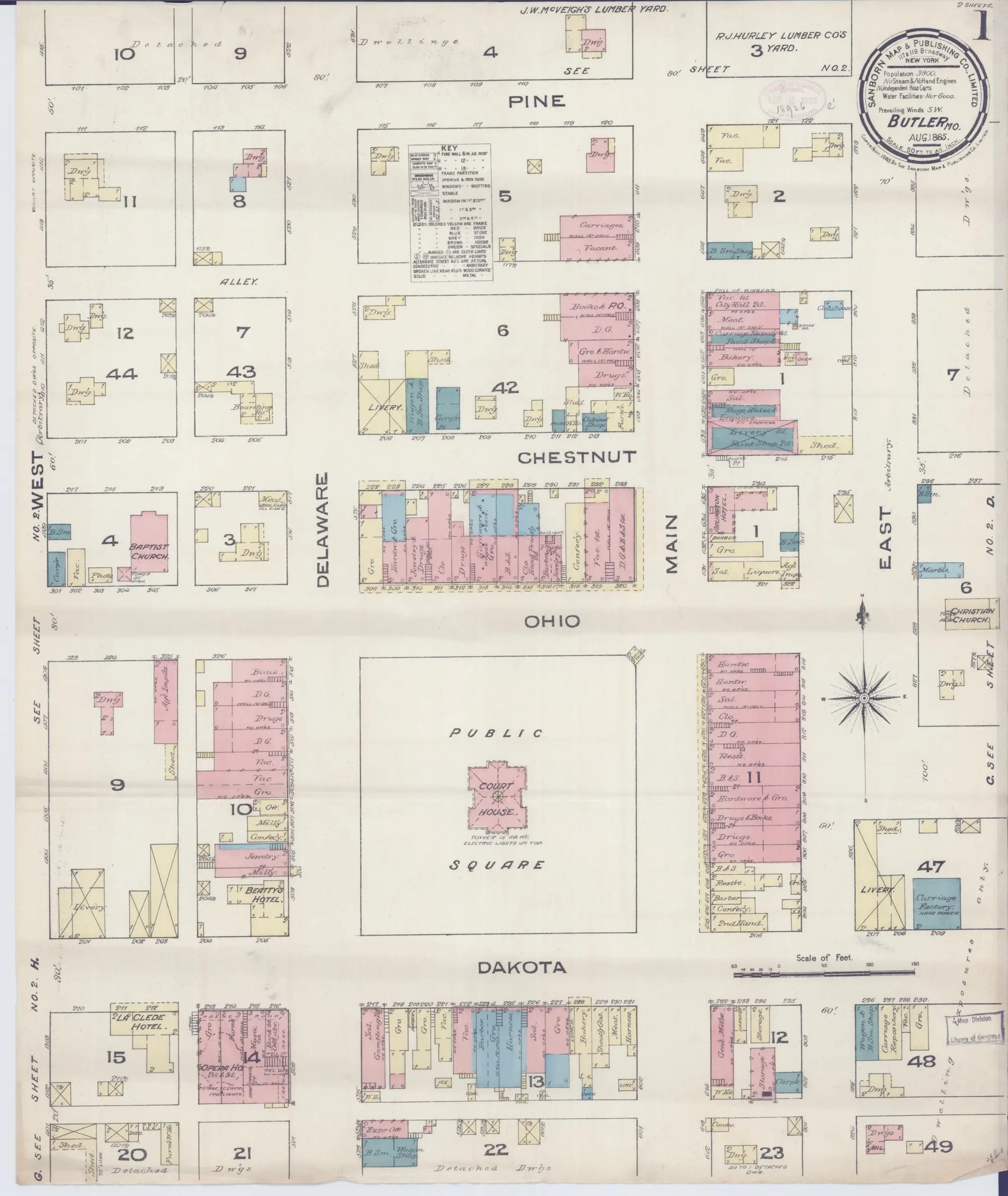
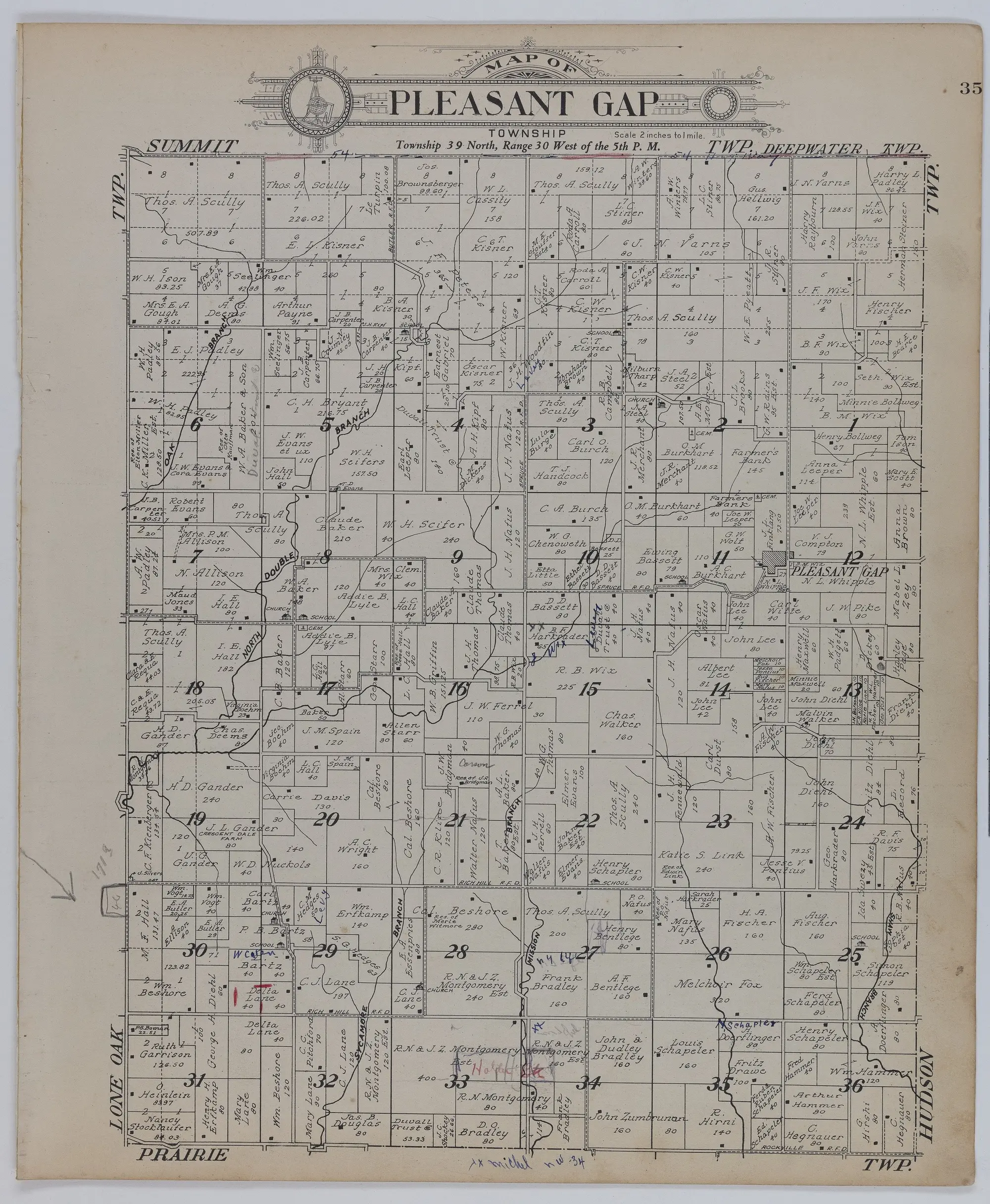
In December 1873 the Bates County Record printed two stray notices from Pleasant Gap Township. Anton Hammer had taken up a bay pony “branded on right shoulder with letter K”, and Carl Hubner a brown steer “with white tail and white in face”; each helped to appraise the other’s stray, and “Leonard Hegnauer” helped to appraise both, at $28 apiece.1, 2 It is the earliest Missouri newspaper item about Leonhard Hegnauer that the study has found, and the first of more than a hundred.3, 4 Hardly any of them is a story in itself: they are names in lists, lines in local columns, a name under a bank’s statement. Read together, they make something better, the public life of a Swiss farmer in a Missouri county, as the local papers printed it.
Candidate, delegate, judge
Most of what the papers say about his politics comes from lists that give only an initial, and the study counts those items as probably, rather than certainly, his.3, 5 In November 1884 the Republicans ran him for county treasurer, and the Democrat, R. S. Catron, beat him by 3,771 votes to 3,072.6 In 1892 he stood for judge of the county court for the Southern District.5, 7 In three issues before the election the Butler Weekly Times printed a sample ballot “for the purpose of giving the voter an idea how to prepare his ballot”, with every ticket but the Democrats’ struck through with a large X, his name included.8–10 On 5 November the Butler Daily Democrat reported the candidate in town the evening before, “heaping coals of fire on the devoted heads of those who sold out a portion of the Republican ticket”.7 The county’s totals gave the seat to Fix, with 1,637 votes, against 1,188 for “Hegenaur” and 933 for Lyle.11, 12
He turns up in humbler lists too: a petit jury in 1893, the judges of election at Pleasant Gap in 1894, the delegates chosen for the convention at Butler in 1902.13–15 The county’s accounts for 1894–95 show “L Hegnauer” paid $1.50 as a judge, a few lines below “C Hegnauer”, whom the study takes for his son Christian, paid the same as a clerk.16 In 1901 the Rich Hill Tribune called him “a reliable Republican always”, and a fortnight later “one of Bates county’s substantial farmers who understands politics as well as agriculture, and exercises the same good judgment in both”.17, 18 The year before, a Butler paper had printed his forecast that Bryan “will not receive a single German vote, except those always Democratic of which there are a few”.19 Later, in Appleton City, he was a judge or clerk at five city elections between 1908 and 1913, the first of them for the same $1.50.19–24
The Bank of Rockville
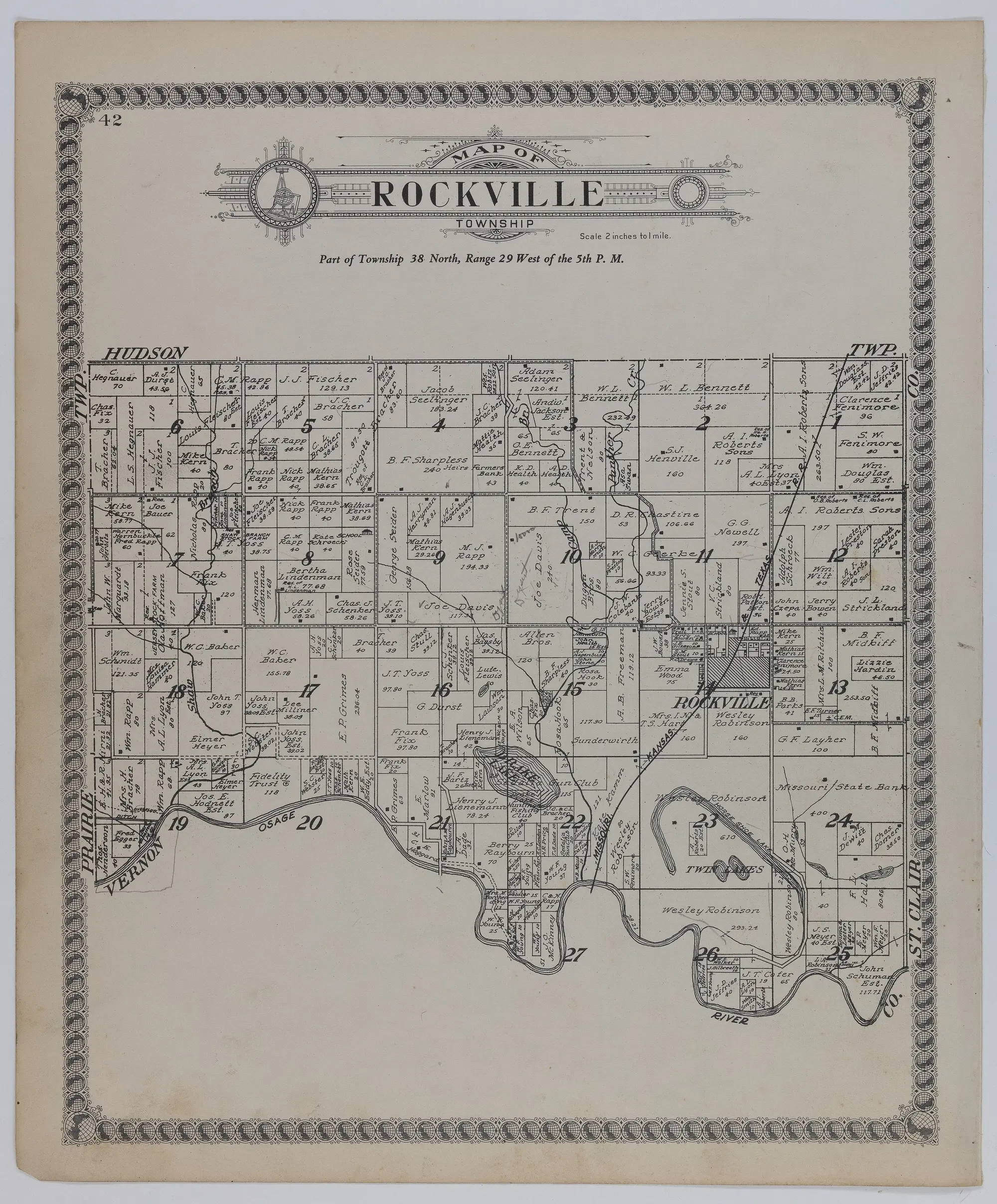
In September 1890 the Appleton City Journal copied from Rockville’s “new and newsy little paper, the Post” the news that a bank was to open there, with $10,000 of capital; “L. Hegnauer, A. Hammer” stand side by side in its list of stockholders.25 In January 1897 he went to a meeting of its directors with “Judge Fix”, and that October the board elected “Ex Judge Fred Fix” president and “L. Hegnauer, vice president”.19, 26 Fix was the man who had beaten him for the judgeship five years before.12 The Rockville Gimlet, copied in Butler, approved:
Messrs. Fix and Hegnauer are good substantial farmers and careful business men, and with Mr. Heyle handling the combination to the cash, the bank is in good and safe hands.27
From 1903 his name stands among the directors attesting the bank’s published statements; the one of November 1906 shows resources of $104,159.34.28, 29 In 1907 the Journal found the bank “housed in a new, modern, up-to-date building, with probably the best burglar proof safe to be found in Southwest Missouri”, with Leonhard as vice-president.30 Its advertisements in the Rockville Booster put the case more briefly: “WE WANT YOUR BUSINESS” in 1908, “WILL GIVE YOU A SQUARE DEAL” in 1909.31, 32
After J. C. Laughlin died in 1911, Leonhard became president.33 In January 1916 the Booster reported that the bank had paid its shareholders “355 per cent in dividends”, and that “during the dark days of financial depression this bank stood between its customers and disaster”.34 When he died that autumn, the Booster talked to the cashier, W. E. Heyle, who had been with the bank for over twenty-five years and had had “experiences which seldom fall to one cashier”: Leonhard was the third of its presidents to die in Heyle’s time, after Frederick Fix and J. C. Laughlin.35
The farm and the fair
In 1891 an “L. Hegnauer”, probably Leonhard, was one of “twenty of the leading farmers and horse breeders of South East Bates” who formed a company to buy an “English Shire” stallion.36 Their committee went to Lincoln, Nebraska, and came back with “a four year old, a dapple bay” weighing 1,800 pounds, for $1,900; Fred Fix was a member too.36, 37 Otherwise the farm seldom reaches the papers; the farmer does, usually on a trip to town. The Rich Hill Tribune saw him “trading with our merchants” in 1902 as “one of Bates county’s best and most prosperous farmers”, “looking as hale and hearty as ever” in 1903, and in 1905 arriving with “a load of produce”: “He is one of our up-to-date farmers.”38–40 In 1910 a correspondent of a Butler paper, “speaking of high prices”, quoted him: “When Tony Hammers and I came to Bates county in 1867 we paid 22 cents a pound for bacon at Papinville.”19
The corn belongs to the youngest son, Robert. In January 1911 the Journal introduced “R. L. Hegnauer, son of Max Hegnauer of this city”, and reprinted a Champaign paper’s report that he had judged its corn exhibit among “experts from the University of Illinois”; the study reads “Max” as a misprint for “Mr. L.”41, 42 In June it printed his certificate as “a fully qualified expert judge of corn”, under the headline “In the Making Good Class”.43 At the fair the Journal reported in September 1912, the premium for white corn went to Green Price; “R. L. Hegnauer”, whom the study takes to be Robert, is listed among the “other entries”, as he is for onions and Irish potatoes.5, 44
A temporary resident
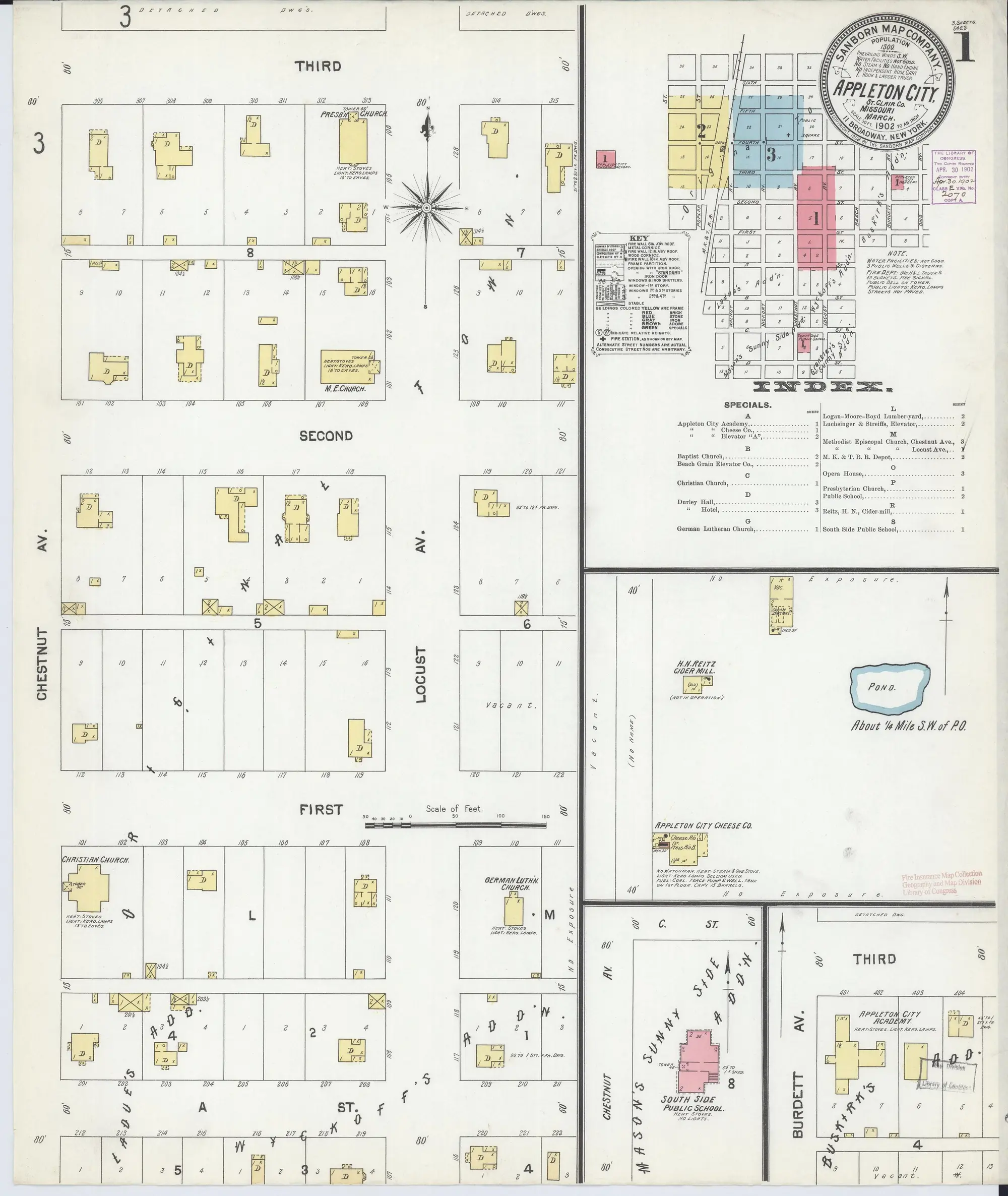
On Tuesday 28 August 1906 Leonhard moved his family over the county line to Appleton City, into “the Deardoff residence in the southwest part of the city”.45, 46 The Journal explained that he was becoming “a temporary resident of the Prairie Queen in order that his son, who is now entering the threshold of manhood, may attend the Academy”.45 The temporary residence lasted the rest of his life.47
In 1907 his son-in-law Joe Link, “in failing health for some time past”, stayed at the house to see a specialist while Leonhard went out to Link’s farm “to look after things”, and that November the house was on the list to be wired for the town’s new electric light.48, 49 The obituary would call him “a great booster for the Appleton City Academy”, and the Journal’s list of those giving to its new building in 1908 includes “L. Hagnauer, 50”.19, 47 In June 1909, when the editor left for El Dorado Springs “In Search of Health”, he put the paper in the charge of three employees of its mechanical department, one of them Robert Hegnauer.50 In January 1910 the Journal was “waiting patiently to hear from” Leonhard and other “old timers” about the last “winter like the present”.51
Each year the family held a reunion at Christian’s farm near Prairie City, “where Grandpa and Grandma Hegnauer formerly lived”.52 On Sunday 22 August 1915 “about sixty people” came; “Mrs. Chris Hegnauer and daughters did themselves proud”, and “there was nothing lacking in quality or quantity of eatables”.52
Deaths and dockets
In September 1916 Joe Link died at Rich Hill “of stomach trouble after an illness extending over several years”, leaving Leonhard’s daughter Katie with seven children.53 A month later Leonhard was “stricken down” on a Friday, and on the Tuesday afternoon, 31 October, he died at home “of paralysis”; the funeral waited until Sunday, “awaiting the arrival of a son, Leonard, from the State of Washington”.54, 55 The Journal’s obituary put the crowd at the German Reformed church north of Prairie City at “one thousand people”, with members of his G.A.R. post as pall bearers; three pages further on, in the same issue, the Pleasant Gap correspondent reported “a large crowd”.47, 56 His post’s resolutions said: “His patriotism was intense and his admiration for the Stars and Stripes of his adopted country were all that could be expected of a native born.”55
The estate went through the probate columns. Letters of administration were granted to Christian on 21 November 1916, and the final settlement was docketed for Tuesday 12 February 1918.57, 58 Susanna died that day, of pneumonia, at Christian’s home.59, 60 The settlement went back on the docket for 14 May.61 After Leonhard’s death she had lived near Prairie City with her children, and to the Pleasant Gap correspondent she was “grand ma Hegnauer”.62, 63 When she died, the same column reported that “this community was shocked when the news came over the telephone that Grandma Hegnauer had gone to her reward”.64 Her brother Gottlieb, a Butler paper noted, “has been out of the Meat Market the past few days”.65, 66
Leonhard’s brother Martin died at his home near Rockville on 27 March 1927. His obituary said that he had been too young to enlist in the Civil War and had stayed at home “to help provide for the mother and younger children while his father and two brothers served”; the Rockville editor added that as his home was two miles out, “he did not mingle much with the life of the town, but was known to be a good and substantial citizen”.67
What the papers leave out
The papers do not always agree. The Booster brought Leonhard to Bates County in 1869; the Journal’s obituary, as the study reads it, took him to Illinois in 1865 and to Bates County the same year; in 1910 he himself said 1867.5, 19, 33, 47 Susanna died on Tuesday 12 February by her death certificate, but on “Wednesday, Feb 13” in the Rich Hill Mining Review.59, 60 Nor could they settle his name. The transcriptions give Hagenauer, Hegnawer, Hegnaer, Hegenour, Hegenaur, Heganaur, Hegnar, Hagnauer, Hegenauer, Hegneaur and Hegnaner; Robert is once the son of “Max”; and the Journal’s probate docket of April 1918 spells him “Lenorad”.7, 11, 13, 33, 41, 43, 45, 61, 68–72 The Booster article that named him the bank’s president printed “Hagnauer”, and the study’s searches missed it; it was found only because its page was already being read.73
What they leave out is larger. Nothing has been found from his years in Illinois and Gasconade County, nothing on any office he held in his church, and the Booster’s issues of November 1916 are not on the newspaper site, so its obituary of him is known only from a Butler reprint.74 Most of all they leave out Susanna. She is in more than a dozen items, always by her place in someone else’s life, as Mrs. L. Hegnauer, Mrs. Fred Hammer’s mother, G. Hirschi’s sister or Grandma Hegnauer, and none of them quotes her.64, 65, 75, 76 In 1900 the census taker noted that she could not speak English; the papers were written in it.77